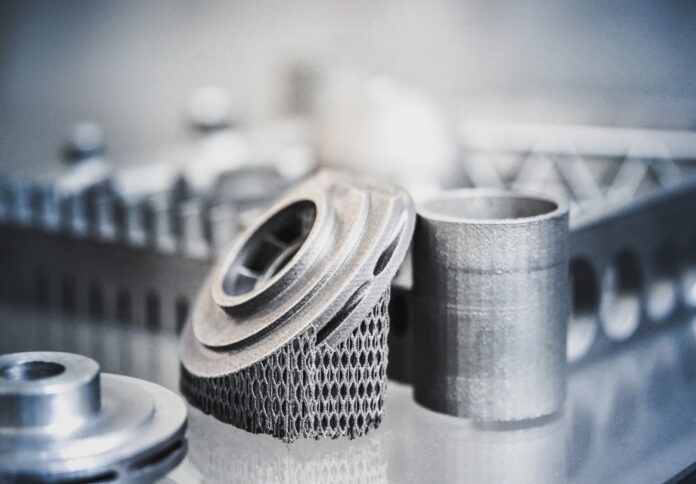
Melotte has announced the operational implementation of a full-process data capturing system at its facility, developed in collaboration with Additive Center and amsight GmbH, as part of its semiconductor component manufacturing activities.
In a joint statement released from Eindhoven, Zonhoven and Hamburg, the companies said the system moves beyond discussions of “data-driven production” in additive manufacturing and into live industrial application.
According to the companies, the implementation integrates Melotte’s entire production chain rather than focusing solely on 3D printer data.
The system captures structured data from the point raw material enters the facility, through the additive manufacturing build process and post-processing stages, to final CT scanning. This creates a connected digital record for each part produced.
The partners said this approach addresses what they describe as the “printer-only” data silo that characterises many existing industry initiatives.
Harry Kleijnen of Additive Center said the project represents a broader view of process control. “The industry often mistakes ‘machine monitoring’ for ‘process control’,” he said.
“What we have achieved with Melotte and amsight is the integration of the total process. We aren’t just looking at the laser; we are looking at the entire lifecycle of the part. This is the first step towards increasing process understanding and thus reducing the use of CT scanning.”
The companies said the semiconductor sector’s requirements for traceability and process stability make such integration particularly relevant. By linking variables ranging from powder chemistry to final internal geometry in a single digital thread, the system is intended to shift quality assurance from inspection-based controls toward process-level data analysis.
They added that the amsight software suite is fully operational within Melotte’s industrial environment and embedded in day-to-day workflows, rather than being limited to a laboratory setting.
Structured process data can now be visualised to assess stability and variation, enabling the introduction of Statistical Process Control (SPC) and deeper process analysis, the companies said.
Looking ahead, the next phase will involve analysing historical production data to identify Critical-to-Quality parameters.
The companies stated this is expected to support reduced inspection overhead while maintaining compliance and predictability, with the broader objective of achieving “first-time-right production” across the semiconductor supply chain.
Additive Center and amsight GmbH described transparent, end-to-end process understanding as essential to the wider industrialisation of additive manufacturing in the semiconductor industry, positioning data-driven quality assurance as a foundational element rather than an optional optimisation.