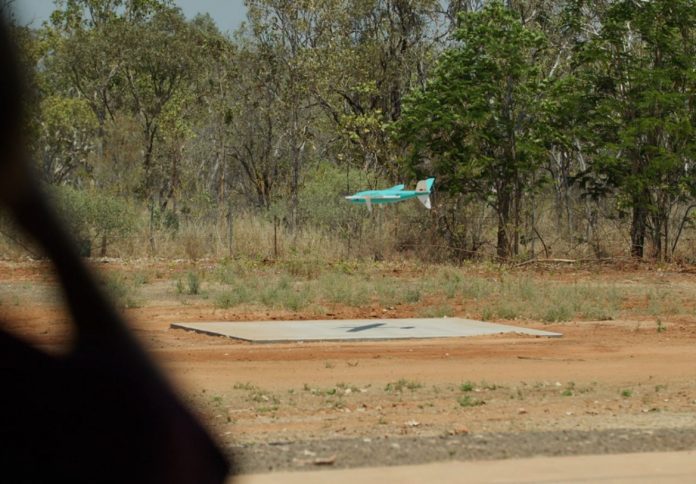
A new drone test flight facility in the Northern Territory will give manufacturers the chance to test their technology in diverse terrain and extreme weather conditions.
The North Australia Centre for Autonomous Systems (NACAS), based at Charles Darwin University (CDU), has launched the Airspace Integration Research Facility (AIR-F), a purpose-designed Unmanned Aerial Vehicle (UAV) test flight facility in northern Australia.
Located at CDU’s Katherine Rural Campus, AIR-F has access to more than 10,000 hectares of sparsely populated land with minimal ground infrastructure and air traffic.
The Civil Aviation Safety Authority has approved the airspace for Beyond Visual Line of Sight operations, and the site is equipped with advanced communication technology.
Alongside testing, the facility has the capacity for research and pilot training and is available for use by Australian and international businesses, industry, and researchers.
NACAS Director Professor Hamish Campbell said AIR-F is positioned to play a central role in Australia’s UAV sector, with UAV flights forecast to grow from 1.5 million to 60.4 million by 2043.
“Australia is investing heavily in the development of UAVs and Advanced Air Mobility in the Defence, civil and commercial sectors,” Professor Campbell said. “However, there are limited places in Australia for manufacturers to test their emerging technologies, with long wait times and high costs at existing test flight facilities.”
He added that AIR-F was designed to address these challenges. “AIR-F is focused only on the testing of uncrewed aerial systems and offers an affordable solution to remote flight operations,” he said.
“Offering low ground and air risk and on-site accommodation, operations room, and maintenance facilities makes the facility a unique and practical testing environment.”
The construction of AIR-F was supported through the Australian Government’s TestLab pilot scheme, with funding from the NT Investment Fund and NT Defence.
Professor Campbell said one of the main advantages of the facility was its ability to test UAVs in both stable and extreme conditions.
“From May to October, the weather is stable, with no rain and light, predictable winds, allowing for reliable flight conditions without cancellations,” he said. “From November until April, the weather is more challenging, with high rainfall and humidity, which enables flight testing under poor air density conditions.”
CDU Deputy Vice-Chancellor Research and Community Connection Professor Steve Rogers said the facility strengthened CDU’s leadership in a rapidly developing field.
“UAV technology is rapidly advancing, and AIR-F is the next step for NACAS and CDU to expand our impact in this space,” Professor Rogers said. “Our connections with Defence and the public and private sectors, our strategic location, and our infrastructure position AIR-F to become a critical player in the UAV market.”
He added that CDU viewed the launch as part of a broader strategy for the Northern Territory. “We are committed to being at the forefront of this innovation, and the launch of AIR-F reinforces our commitment to strengthening our strategic position in the north and expanding the Northern Territory’s capabilities nationally and beyond.”
Since its inception in 2022, NACAS has expanded its research and training efforts, including projects using drones and artificial intelligence to detect ghost nets and trials of UAVs for medical supply delivery.