
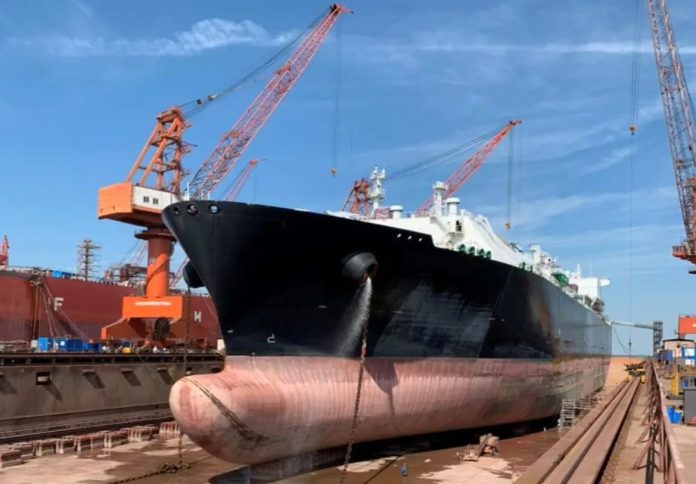
Manufacturing expertise from London-based additive manufacturer 3D People has been used to produce a critical component for a maritime efficiency system trialled on a liquefied natural gas carrier.
In its release, 3D People said it was engaged by Liverpool-based Armada Technologies to manufacture a precision ejector for the company’s Passive Air Lubrication System (PALS), a technology intended to reduce fuel use and emissions by releasing microbubbles beneath a vessel’s hull to lower drag.
3D People said the manufacturing challenge centred on producing an ejector capable of withstanding continuous flow, high pressure and corrosive seawater, while maintaining the internal geometries required for the system to function as designed.
The company said traditional manufacturing techniques were assessed but were unable to meet those requirements, leading Armada to adopt industrial additive manufacturing.
“3D People stood out immediately,” Armada Technologies chief operating officer Roger Armson said in the release.
“They understood the complexity of the part, grasped our technical needs quickly, and delivered prototypes that met our stringent functional and compliance requirements.”
According to 3D People, the component was manufactured using PA12 nylon via selective laser sintering, with vapour smoothing applied to improve surface interaction.
The company said production was completed across four batches and that the parts have remained in operation for eight months since installation.
3D People co-founder Sasha Bruml said the project demonstrated how manufacturing choices can directly influence engineering performance.
“We love projects where additive manufacturing isn’t just convenient, it’s transformative,” Bruml said, adding that the collaboration showed how additive manufacturing could support sustainable engineering outcomes.
Co-founder Felix Manley said the company’s involvement extended beyond production. “Our role isn’t just to print parts, but to help solve problems,” Manley said, noting that the work reflected the company’s focus on complex manufacturing for demanding environments.
In its statement, 3D People said the collaboration highlighted the growing role of production-grade additive manufacturing in maritime and other industrial sectors as companies pursue efficiency and emissions reductions, while continuing to evaluate the performance and scalability of emerging technologies.