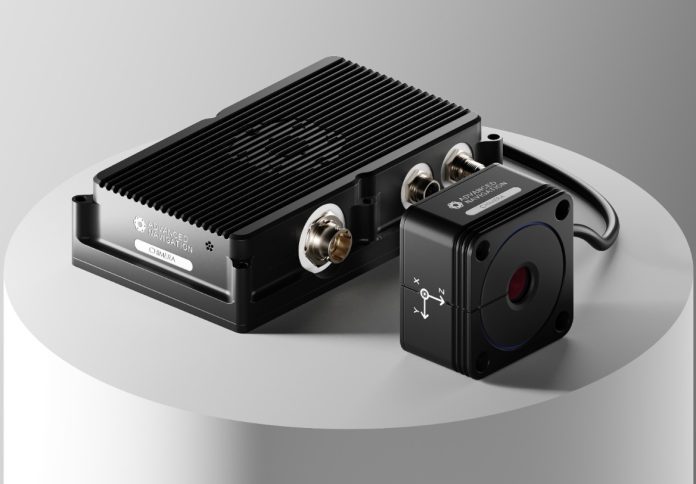
Advanced Navigation has launched Chimera Land, a new 3D Laser Velocity Sensor (LVS) technology designed to improve vehicle positioning in deep underground mining environments where GPS signals cannot reach.
In a media release, the company says the system represents a new class of navigation technology aimed at solving one of mining’s longstanding operational challenges – maintaining precise localisation in dark, dusty, and unmapped underground settings.
According to Head of Product Joe Vandecar, reliable positioning is critical in production mining environments.
“When positioning fails, haulage stalls, drill rig alignment drifts, and ore reconciliation becomes inaccurate,” Vandecar said. “These disruptions create a cascade of operational lag that directly erodes profitability.”
Traditional underground navigation systems often rely on fixed infrastructure such as Wi-Fi beacons or radio tags, which can be costly to install and maintain as mining faces extend deeper underground.
Advanced Navigation said Chimera Land was developed to reduce dependence on such external networks.
The technology uses specialised lasers to measure a vehicle’s ground-relative three-dimensional velocity and integrates the data with the company’s inertial navigation system (INS). By feeding high-precision motion data into the INS, the system aims to counteract the natural drift that typically affects standalone inertial sensors over time.
According to the company, the integration is powered by the company’s proprietary AdNav Intelligence software, which employs adaptive algorithms to dynamically balance inputs from multiple sensors based on environmental conditions and reliability assessments.
“Development areas in mining have long been held back by fragile external infrastructure and complex setups that struggle to keep pace with a moving mine face,” Vandecar said. “Chimera Land changes that. By providing a fully onboard, self-contained solution, we’ve eliminated the positioning gap.”
The technology was demonstrated in Europe’s deepest underground mine, located 1.4 kilometres below the surface, as part of BHP’s Deep Mining Call. When paired with the company’s Boreas D90 INS, the system achieved position accuracy of 99.9% of distance travelled without relying on pre-existing maps or fixed infrastructure.
Performance testing showed a final position error of 15.9 metres over a 22.9-kilometre transit, with an inertial drift rate of 0.07% per distance travelled. The results were validated across five separate runs, each recording accuracy better than 0.1%.
The company said the technology is designed to support deeper mining operations as geological resources become harder to access and infrastructure costs rise.
Applications include autonomous haulage systems, high-precision machine guidance for drilling and scaling equipment, and real-time fleet tracking in low-visibility conditions.
“To keep human operators safe from hazardous conditions, assets must possess the ‘situational intelligence’ to make real-time decisions,” Vandecar said. “Chimera Land provides the foundational certainty required for this evolution.”