Australia’s national science agency CSIRO says it has successfully trialled AI-powered autonomous robots designed to improve maintenance at large-scale solar farms, with the aim of enhancing safety, reducing costs and supporting more reliable energy generation.
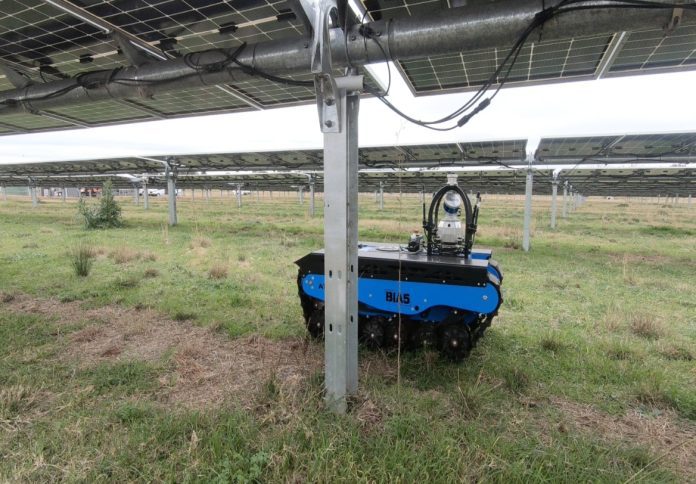
According to CSIRO, the robots – repurposed from systems originally developed for the mining industry – are capable of navigating vast solar farm sites across uneven and high-temperature terrain, where inspections are traditionally carried out manually.
The agency said this approach can expose workers to safety risks and increase operational costs, CSIRO said in a news release.
Large-scale solar farms can generate more than 500 megawatts of electricity, enough to power over 300,000 homes, but maintaining performance depends on regular inspection of photovoltaic panels and supporting infrastructure.
CSIRO said its robotic system applies artificial intelligence, automation and advanced sensors to enable predictive maintenance and continuous monitoring.
The robots are equipped with LiDAR for 3D mapping, RGB cameras for visual inspection and thermal infrared cameras to detect electrical faults. CSIRO said the system can identify issues such as dust accumulation, bird droppings, insect nests, structural faults, loose components and hotspots that may affect panel efficiency.
CSIRO Senior Photovoltaic Engineer Kenrick Anderson said early detection of faults is critical to maintaining output.
“Hotspots decrease the efficiency of a PV panel over time, because of the electrical and thermal imbalance they cause within the module,” he said. “If solar farms cost less to run, and can be more consistent in their energy output, this increases the stability of the grid.”
Senior Principal Research Scientist Peyman Moghadam said the technology is part of a broader shift toward data-driven operations.
“We are not just collecting images or 3D data. We are building the foundations for intelligent solar operations, where data from robots, fixed sensors and field systems can be combined,” he said. “This supports better proactive maintenance decisions and more resilient performance over time.”
CSIRO said integrating robotics into solar operations can reduce the need for manual inspections, improve efficiency and safety, and extend asset lifespan. It also noted the potential for new skilled roles in regional areas, particularly in robotics support and data analysis.
Senior Robotics Engineer Ross Dungavell said the technology addresses workforce challenges in remote locations.
“Often you cannot get someone to go out there under such harsh conditions, for extended periods of time,” he said. “The robot logs and stores every piece of data it captures, its sensors are able to find any fault a panel might have.”
CSIRO said it is currently trialling the system at pilot sites across Australia and is seeking industry partners to expand deployment, with the goal of improving renewable energy reliability as part of the broader energy transition.