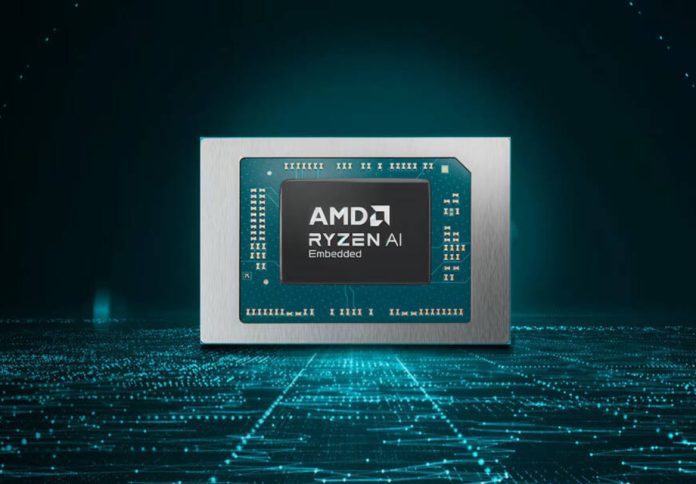
AMD has expanded its Ryzen AI Embedded P100 Series, unveiling processors aimed at manufacturing, industrial automation, robotics, and other AI-driven edge applications.
In a news release, AMD said the new chips offer up to twice the CPU cores, up to eight times higher GPU compute, and an estimated 36 per cent increase in system performance compared with previous models, all within the same compact footprint.
The processors feature eight to 12 “Zen 5” cores, RDNA 3.5 graphics, and a neural processing unit based on AMD’s XDNA 2 architecture. AMD said the integration of CPU, GPU, and NPU components on a single chip supports real-time AI workloads, deterministic performance, and 24/7 operation for industrial and medical applications.
AMD highlighted support for its open-source ROCm software ecosystem, which allows developers to run standard AI frameworks and access embedded-ready models without rewriting code.
A virtualised reference stack based on the Xen hypervisor enables multiple operating systems, including Linux, Windows, and RTOS environments, to run in isolated domains for safety and flexibility.
Industry partners are already building solutions using the processors. Aaron Su, VP of Embedded IoT at Advantech, said the portfolio “leverages an enhanced integrated AI architecture to deliver high-efficiency multitasking that drives next-generation edge AI advancement.”
Florian Drittenthaler, product line manager at congatec, described the platform as giving customers “extraordinary flexibility to tailor performance, power, and cost to their specific application needs.”
Thomas Stanik, senior manager at Kontron, added that the processors allow compact systems that “deliver high compute performance and AI acceleration in the same footprint.”
AMD said eight- to 12-core processors are currently sampling, with production shipments expected in July 2026. Four- to six-core models are also sampling, with production slated for the second quarter of 2026.