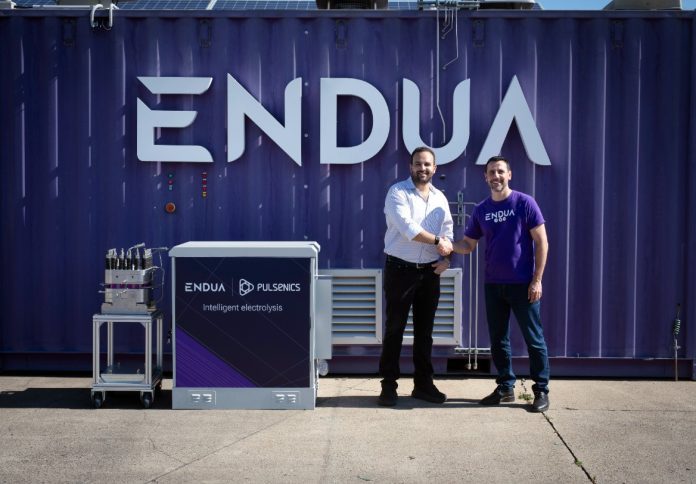
Pulsenics, a Toronto-based provider of electrochemical monitoring technology, and Endua, a Brisbane-based developer of on-site green hydrogen systems, have announced what they describe as the world’s first commercial deployment of AI-enabled spectrum scanning for hydrogen electrolysers.
In a joint statement, the companies said the collaboration combines Pulsenics’ proprietary Pulse Probe hardware with Endua’s on-site hydrogen electrolysis stacks to enable real-time monitoring under highly variable solar power conditions.
The deployment, they added, aims to improve system reliability, predictability, and cost-efficiency in green hydrogen production.
According to Endua and Pulsenics, the initiative marks a significant step forward for the hydrogen manufacturing sector by allowing producers to directly connect electrolysers to solar farms, bypassing the electricity grid and avoiding associated infrastructure costs.
This approach, they noted, introduces challenges due to intermittent renewable energy inputs — challenges their partnership seeks to address through advanced machine learning and electrochemical analysis.
Pulsenics’ Pulse Probe series applies electrochemical impedance spectroscopy (EIS), a diagnostic technique widely used in research but now deployed commercially for the first time in hydrogen production.
The company said the system uses AI to synthesise continuous scanning data across multiple frequencies to provide early failure warnings, track degradation, and optimise operations for cost-effective energy use.
“Green hydrogen can compete with other energy technologies when we use the world’s cheapest power,” Pulsenics COO and Co-Founder Mariam Awara said in the announcement.
“Pulsenics will close the knowledge gap between renewable inputs and electrolyser performance to help optimise hydrogen plants for real-world conditions.”
Endua said the integration of Pulsenics’ monitoring technology also supports commercial certainty for hydrogen producers and equipment manufacturers.
By improving data visibility on uptime, degradation, and performance, the companies said, the system helps de-risk investment decisions and enhance trust in performance guarantees.
“Industrial hydrogen users want to create their own supply on-site, and they need guarantees on performance and uptime,” Endua CEO Paul Sernia said.
“AI analytics from Pulsenics helps us to offer the latest high-performance technology and deliver on these promises to our customers,” he concluded.