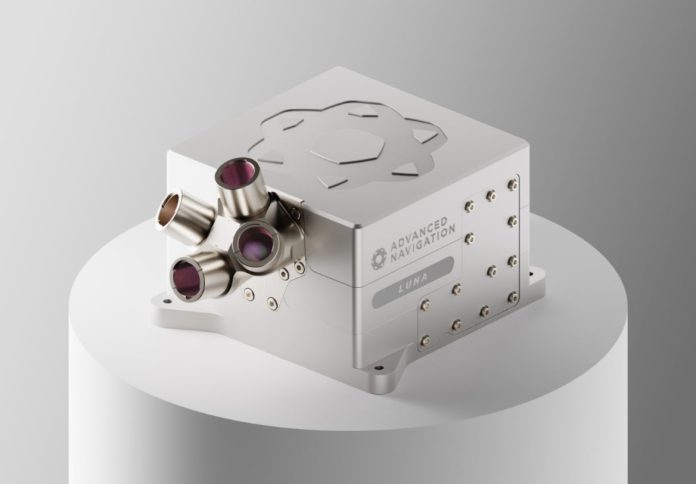
Australia’s Advanced Navigation has announced that its LUNA (Laser measurement Unit for Navigation Aid) sensor has completed a critical phase of terrestrial validation, moving the technology closer to its planned deployment on a future lunar mission.
The company said the LUNA sensor, designed to guide landers and rovers with high-precision “laser vision” in GPS-denied environments, exceeded performance benchmarks set by commercial lunar surface delivery provider Intuitive Machines during Earth-based trials.
In a news release, Advanced Naviagation stated that LUNA is now progressing to final space qualification ahead of integration into Intuitive Machines’ IM-4 Nova-C class lander, scheduled to deliver NASA payloads to the lunar South Pole in 2027.
“For decades, landing on the Moon has meant flying with only partial vision in the final kilometres,” said Chris Shaw, CEO and co-founder of Advanced Navigation.
“With no GPS to guide them, landers depend on a combination of sensors that can introduce drift or deliver incomplete data. Our LUNA sensor aims to give lunar landers and rovers hyper-accurate ‘laser vision’ to see their own speed and position in the darkness of space, potentially making crashes a thing of the past and paving the way for safe, autonomous exploration.”
The company noted the sensor demonstrated its performance in several test campaigns designed to replicate lunar conditions. In Western Australia’s Pinnacles Desert, a LUNA unit mounted on a light aircraft recorded a 28-metre error over 100 kilometres of GPS-denied flight.
Trials in Europe’s deepest mine in Finland produced best-case 3D position errors of 0.55 metres and an average error of 2.83 metres over a six-kilometre course, results Advanced Navigation said surpassed standard GPS accuracy under open-sky conditions.
Dr Tim Crain, Chief Technology Officer at Intuitive Machines, said the Australian company’s lightweight design supports both performance and efficiency goals.
“Advanced Navigation’s lightweight, high-performance sensor aligns with our strategy to reduce mass while increasing capability — and it complements our precision landing technology by adding critical velocity and altitude data during descent,” Dr. Crain said.
The company said the LUNA system incorporates the AAO LUNA Optical Head Assembly (ALOHA), a set of four telescopes developed by Australian Astronomical Optics (AAO).
“We’ve battle-hardened our ALOHA system to survive the intense journey to the Moon,” said Lee Spitler, Head of Space Projects at AAO. “Its four space-qualified telescopes deliver the laser beams that power the LUNA sensors’ ‘sight’, providing the critical velocity and range data the Nova-C lander needs to stick the landing.”
The company noted the final qualification phase will include vibration, shock, electromagnetic compatibility, and thermal vacuum testing to confirm mission readiness for launch on a SpaceX Falcon 9 rocket.
Enrico Palermo, head of the Australian Space Agency, said the technology highlights national expertise. “The LUNA sensor is a testament to the talent and innovation within the Australian space sector and paves the way for our nation to play an even greater role in the future of lunar exploration,” Palermo said.
Advanced Navigation said that alongside its lunar applications, a terrestrial version of LUNA integrated with the company’s Boreas inertial navigation system will be available commercially in late 2025 for use in GPS-denied environments on Earth.