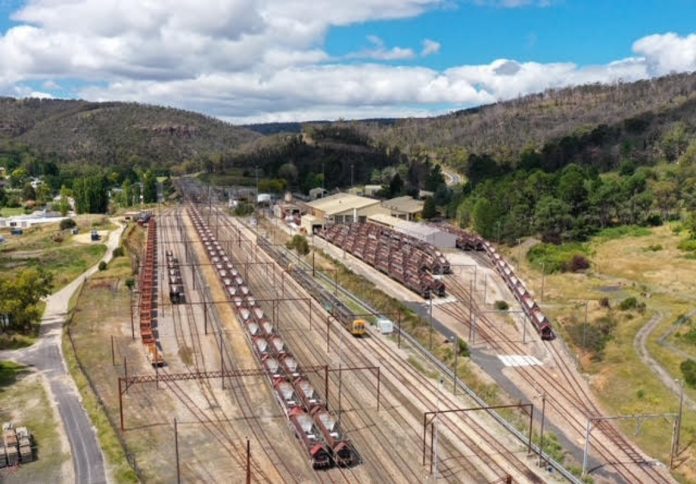
Manufacturing jobs have become a central issue in Lithgow as community groups step up calls for government action to secure the future of the long-vacant Lithgow Locomotive Workshop, arguing the site could underpin both traditional rail manufacturing and emerging battery-electric train production.
According to a media release from Lithgow Community Power Project Inc., members of the Australian Labor Party voted unanimously at the NSW Labor Country Conference for state and federal governments to purchase the workshop site from Pacific National, returning it to public ownership.
The workshop, which occupies a large portion of Lithgow’s industrial land, has been vacant for several years despite its location at the junction of electrified and non-electrified rail networks.
Community advocates say the site could support rail manufacturing, maintenance and new battery-electric train projects as the region transitions away from fossil fuel industries.
“Returning ‘the Loco’ to public ownership has always been a no-brainer,” said David Peters, chair of Lithgow Community Power Project.
“If it’s returned to public ownership, it can be leased out to private sector businesses with commercially viable uses for the site, so that it’s productive, creates jobs and income for the Lithgow community and the state of NSW.”
Pacific National has rejected a bid from Southern Shorthaul Rail, which currently employs around 30 maintenance staff and is seeking workshop space, and is poised to sell the site to a property developer. Mr Peters said this raised concerns the land could remain idle for years.
“We dreaded the site being land-banked where developers do nothing for another five years,” he said, adding that rail workers were currently carrying out maintenance work outdoors due to a lack of suitable facilities.
The campaign has also highlighted Lithgow’s history in rail manufacturing, including the design and manufacture of Australia’s only operating battery-electric passenger train. Dr Michelle Zeibots, a transport planner at the University of Technology Sydney, said the site could play a role in future low-emissions rail projects.
“Lithgow’s unique human capital could help the Federal Government reach their ambitious targets for battery-electric train trials,” Dr Zeibots said, while noting that emerging manufacturers may require government support to make use of a site of that scale.
Support for the campaign has also come from Lithgow City Council, which has backed calls for government intervention. Mayor Cassandra Coleman said manufacturing and rail jobs were critical to the local economy following recent coal industry closures.
“Lithgow needs jobs,” Cr Coleman said. “The rail industry and NSW need access to railway workshop space because there’s a chronic shortage. Government needs to help realign existing rail and new net-zero rail manufacturing businesses with critical infrastructure.”
The Lithgow Community Power Project said it was now urging both levels of government to act on the conference motion and engage with local rail businesses on potential manufacturing and leasing opportunities at the site.