La Trobe University has announced progress in a research and innovation partnership designed to boost food productivity and support the international expansion of controlled-environment agriculture technology, the university said.
The development centres on a world-first hydroponic food productivity system supported partly by the La Trobe Eagle Fund, a joint investment initiative between La Trobe and Breakthrough Victoria.
According to La Trobe, the system has now achieved a commercial milestone with the launch of its first production greenhouse and the establishment of an agreement to deploy the technology in India.
La Trobe said the hydroponic system was originally developed with researchers from its School of Computing, Engineering and Mathematical Sciences and the School of Agriculture, Biomedicine and Environment for the NASA Deep Space Food Program.
The university added that the engineering work later formed the basis of the YieldX platform.
The Eagle Fund contributed $1 million of a $1.75 million seed funding round last year to advance development and commercialisation, La Trobe said. The remaining seed funding was provided by Mandalay Venture Partners and LaunchVic’s Hugh Victor McKay Fund.
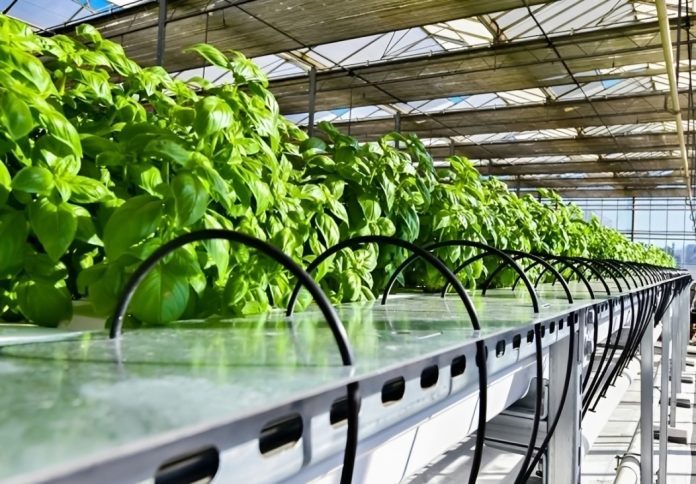
La Trobe said the YieldX system is now operating at commercial scale inside a 4,000 square metre protected cropping greenhouse at Butler Market Gardens in Lyndhurst, Victoria.
The university said the commercial pilot has demonstrated intelligent optimisation of plant spacing and is projected to increase basil production by up to one million plants annually if applied across the full greenhouse footprint.
The technology is also set to be established in India under a multi-year agreement with Hyperpure by Zomato, the fresh supply chain arm of Zomato.
La Trobe said the deployment will focus on controlled environment agriculture sites in and around New Delhi to support supply chain reliability during extreme seasonal conditions, including summer heat and monsoon weather.
La Trobe Deputy Vice-Chancellor Research and Innovation Professor Chris Pakes said the project demonstrates the university’s role in translating research into commercially viable innovation.
Professor Pakes said the partnership shows what can be achieved when academic research is combined with industry collaboration to address global food system challenges.
“We are delighted that through our partnership with Breakthrough Victoria, the La Trobe University Eagle Fund is helping bridge the gap between research and commercialisation,” Pakes said, adding that the initiative draws on La Trobe’s research strengths across biotechnology, agricultural technology and biomedical science.
YieldX Chief Executive Officer and Chief Technology Officer Nadun Hennayaka said the milestone reflects years of engineering and commercial development, noting that the NASA program helped validate the core technology.
Hennayaka said the company’s long-term goal was to improve farming productivity on Earth by making advanced growing systems more accessible to commercial growers.
Butler Market Gardens Chief Executive Officer Rick Butler said the pilot aligns with industry demand for higher production capacity and greater labour efficiency. He said horticulture businesses must continue adopting new technologies to remain competitive.
The YieldX system was supported by La Trobe researchers Dr Alex Stumpf, Adam Console and Fernando Galetto, who contributed to the NASA Deep Space Food Challenge by helping develop vertical farming prototypes.
La Trobe said the Lyndhurst demonstration site is now open to growers, distributors, investors and other industry stakeholders to observe the system in operation and review performance data on crop density, yield and land-use efficiency.