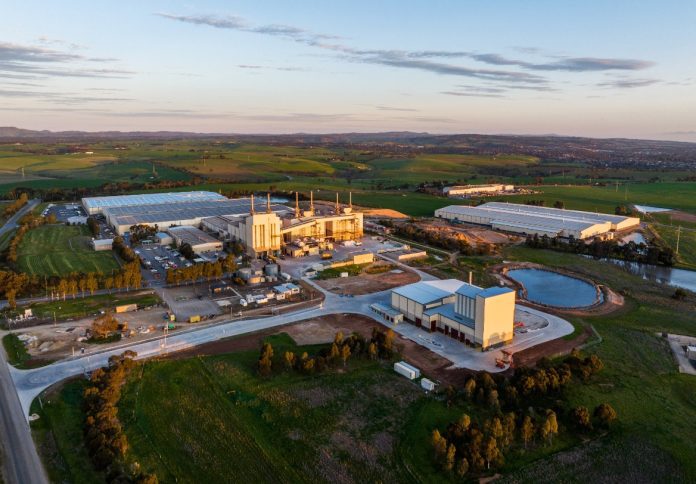
Orora, a manufacturer of sustainable packaging for the beverage industry, is marking the first 12 months of operation for its G3 oxyfuel glass furnace at its Gawler, South Australia, manufacturing site.
In a news release, the ASX-listed company said the upgraded furnace has reduced natural gas consumption and greenhouse gas emissions, highlighting advances in emissions reduction for energy-intensive manufacturing.
The $130 million rebuild, supported by a $12.5 million Australian Government grant under the Modern Manufacturing initiative, has cut natural gas usage by 32 per cent, eliminating more than 13,000 tonnes of carbon dioxide (CO2) emissions annually.
Nitrogen oxide (NOx) emissions have fallen by over 70 per cent compared with the previous furnace design. According to Orora, the results demonstrate the potential of oxyfuel technology to decarbonise industrial processes while maintaining production at scale.
“The G3 furnace represents a step change in how glass is manufactured in Australia,” said Greg Savage, Senior Vice President, Orora Glass Asia Pacific.
“Achieving a reduction of more than 70 per cent in NOx emissions and cutting over 13,000 tonnes of CO2 in the first year alone demonstrates that investment in advanced technology can deliver measurable environmental outcomes while continuing to meet the needs of our customers.”
The company said the furnace replaces a traditional air-fuel design with oxyfuel melting, removing nitrogen from combustion to operate at higher thermal efficiency. It also nearly doubles electric boosting capacity, further reducing reliance on natural gas. Combined with increased use of recycled glass, total CO2 savings now exceed 27,000 tonnes per year.
Orora’s onsite glass beneficiation plant has further enhanced the furnace’s sustainability performance, increasing recycled glass usage by more than 30 per cent.
Peak production periods have achieved up to 90 per cent recycled content, equivalent to processing 150,000 tonnes of glass annually – about 330 million wine bottles or 750 million beer bottles – delivering an additional 14,000 tonnes of CO2 savings per year.
The Gawler furnace produces more than 475 tonnes of glass daily, making it Australia’s largest glass furnace and demonstrating that emissions reductions and industrial scale can advance together.
Looking forward, the furnace forms a key part of Orora’s strategy to reduce emissions intensity per tonne of glass by 60 per cent and increase post-consumer recycled content in coloured glass to 68 per cent by FY35.
“We are proud of what has been achieved in the first year, but this is only the beginning,” Savage said. “Our focus remains on continuous improvement and investing in technologies that deliver lasting value for our customers, our communities and the environment.”
The content of this article is based on information supplied by Orora Ltd. For more information, please refer to the official company announcement and communications from Orora. Please consult a licensed and/or registered professional in this area before making any decisions based on the content of this article.