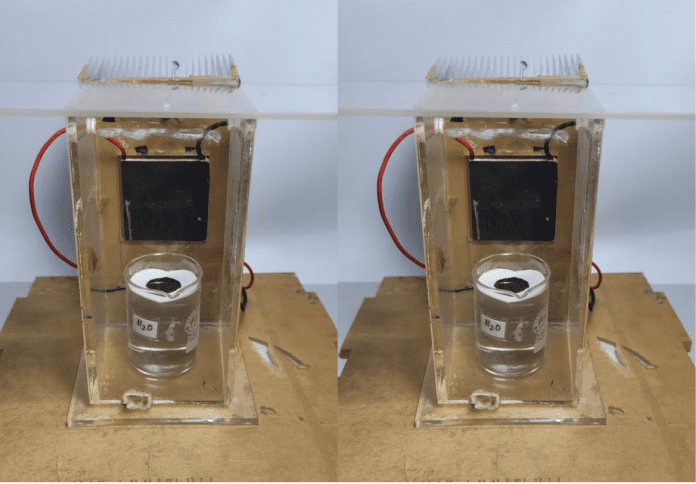
Monash University and the Indian Institute of Technology Bombay have developed a solar-powered desalination prototype capable of producing continuous drinking water, addressing a common limitation in existing systems.
The device, called SunSpring, uses a floating porous membrane embedded with microscopic carbon structures that absorb sunlight and generate heat. This allows seawater to be distilled, producing up to 18 litres of fresh water per day.
In a news release, the university said the membrane is designed to prevent salt accumulation, a problem that often reduces the effectiveness of long-term desalination systems.
“This solar still, which we have called SunSpring, generates up to 18 litres of fresh, drinkable water per day from seawater and can operate continuously without becoming clogged by salt deposits,” said Professor Neil Cameron, Monash Warwick Alliance Professor of Polymer Materials at Monash Materials Science and Engineering.
Housed in a clear perspex enclosure to separate evaporation from condensation, the system is aimed at communities in remote or economically disadvantaged areas without reliable electricity, as well as arid regions facing water scarcity, the university noted.
Researchers stated that nearly 30 per cent of the global population lives in regions where high water stress coincides with limited resources and strong solar exposure.
The team is refining the SunSpring design ahead of field trials, with commercial development to be considered after testing and optimisation of larger-scale versions.
The research has been published in Advanced Science and is available here.