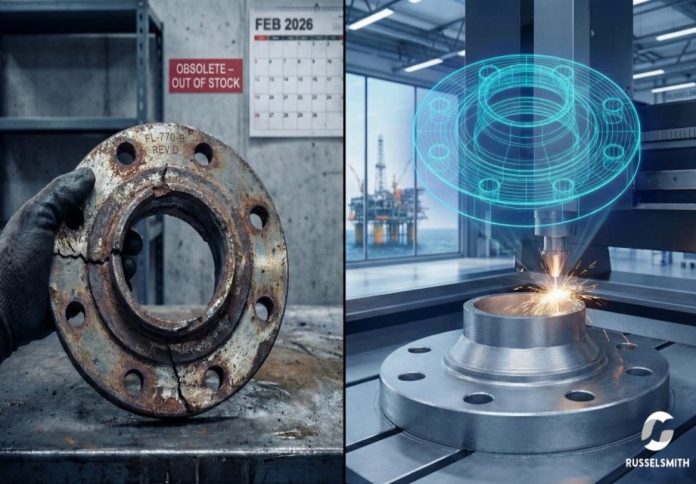
Additive manufacturing is emerging as a potential solution to costly spare-parts delays in the oil and gas sector, with companies exploring on-demand production methods to address supply chain gaps that contribute to millions in annual downtime, according to information released by RusselSmith.
In a news release, the Nigeria-based company said maintenance challenges tied to ageing equipment and limited supply chains continue to disrupt operations across the industry.
Citing a 2022 predictive maintenance report by Siemens’ Senseye unit, offshore oil and gas facilities experience an average of $149 million annually in costs linked to unplanned downtime, underscoring the financial impact of equipment failures.
Production interruptions can quickly escalate into major operational losses. Industry estimates place the cost of unplanned downtime between $125,000 and $500,000 per hour, depending on production capacity and market conditions. When oil prices rise, the financial consequences increase further as lost production becomes more expensive.
RusselSmith noted that many of these disruptions stem from long lead times for specialised components. In conventional supply chains, industrial parts can take 12 to 30 weeks to manufacture and deliver, while legacy components for older equipment may require 12 months or more if original manufacturers have ceased production.
“The oil and gas industry has billions of dollars of spare parts in inventory at any given time,” said Carlo De Bernardi, Additive Manufacturing Lead at ConocoPhillips, highlighting what RusselSmith described as a persistent supply chain paradox in which operators maintain large inventories yet still lack critical components when failures occur.
RusselSmith said the issue is particularly acute in regions with ageing energy infrastructure and complex logistics networks.
In parts of West Africa, oil and gas facilities often rely on overseas suppliers, and transporting equipment to remote or offshore locations can add further delays due to customs processes, infrastructure limitations, and security concerns.
According to the company, industrial additive manufacturing — often referred to as industrial 3D printing — offers an alternative approach by allowing spare parts to be produced on demand from digital design files rather than stored in large physical inventories.
Under this model, validated computer-aided design files are stored in digital libraries and transmitted to qualified manufacturing facilities when components are required. RusselSmith said the parts can then be produced locally or near the operating site, reducing logistics delays.
Industry case studies cited by the company indicate the potential for significant efficiency gains. In one example involving check valves, additive manufacturing reduced lead times from more than 52 weeks to around one week, while lowering component weight by 15% and cutting total cost of ownership by at least 30%.
RusselSmith said the technology can also support emergency repairs. In some cases, components with conventional lead times of 12 to 16 weeks have been reverse-engineered and produced within two to three weeks, allowing faster restoration of critical systems.
However, the company noted that additive manufacturing is not suitable for every spare part. The approach is considered most effective for low-volume, high-value components, obsolete or legacy parts, and equipment operating in remote locations where logistics delays are common.
Industry standards have also been developed to support the safe use of additively manufactured components in energy infrastructure. Frameworks such as DNV’s DNV-ST-B203 standard and the American Petroleum Institute’s API 20S specification provide qualification pathways for metal additive manufacturing in oil and gas applications.
RusselSmith said many operators are adopting the technology gradually, often working with specialist additive manufacturing providers to identify suitable components, reverse-engineer legacy parts, and build secure digital inventories that can be produced on demand.
The company added that wider adoption could also support regional manufacturing development, particularly in areas where oil and gas supply chains rely heavily on imported components.
According to RusselSmith, additive manufacturing offers operators an opportunity to move away from inventory-heavy spare-parts models toward more flexible supply chains capable of responding quickly to equipment failures.
“In an industry where every hour of downtime carries six-figure costs, the economic case for action is compelling,” the company said, adding that developing local manufacturing capacity could help strengthen long-term industrial competitiveness in regions such as West Africa.