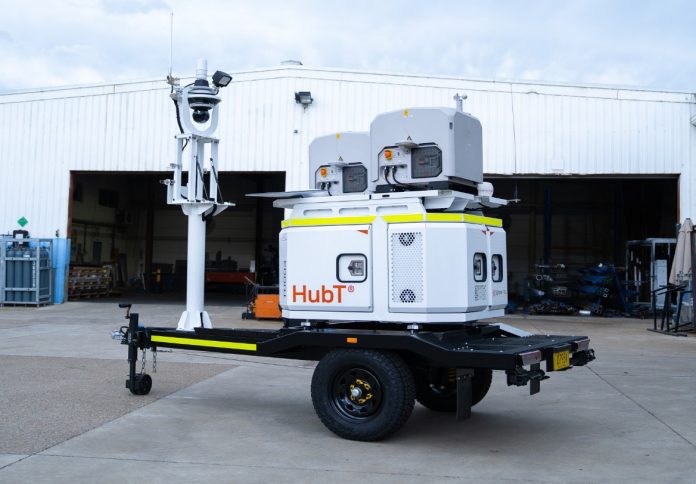
Sphere, an Australian full-stack technology and services provider with offices across Australia, says a move to bring manufacturing of its HubT autonomous drone hardware fully in-house is central to a series of upgrades aimed at improving deployment speed and reliability.
In a news release, the company said the manufacturing transition, which includes electrical integration and compliance testing, is intended to enable faster and more consistent rollout of its remote data capture platform across a range of industries.
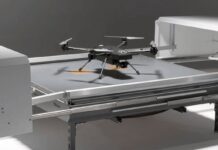
Sphere announced updates to HubT, a plug-and-play system designed to support fixed-site autonomous drone operations, with changes focused on reducing deployment time while maintaining its role as a ready-to-install sensor stack for DJI Dock 3 and beyond visual line of sight (BVLOS) infrastructure.
A key feature of the update is the introduction of two deployment configurations – Trailer and Skid – designed to accommodate varying site conditions.
The Trailer option is suited to uneven terrain, while the Skid configuration is intended for flat, stable surfaces such as concrete.
According to Sphere, this flexibility reduces the need for site preparation and civil works typically associated with more rigid systems, potentially lowering upfront infrastructure requirements.
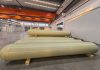
The company said it has also brought the entire HubT production cycle in-house, covering enclosure fabrication, electrical design, wiring, integration and compliance testing. This includes employing qualified electricians as part of its internal production team.
Sphere said the vertically integrated manufacturing model is expected to reduce delays and inconsistencies linked to third-party contractors, while providing greater control over production scheduling and quality assurance.
Chief executive Paris Cockinos said the shift reflects a broader strategy to streamline production and deployment.
“We made a deliberate decision to employ electricians in-house and manufacture HubT ourselves, rather than outsource assembly to contractors,” Cockinos said.
“That gives us something most providers in this space can’t offer: a rapid, repeatable production cycle where we control every step from design through to a compliance-certified, site-ready unit.”
The updated system has been engineered to align with Australian standards including AS/NZS 5368:2025 and AS/NZS 3001 series, and has undergone independent engineering review and audit, the company said.
Sphere added that designing the electrical system to meet these standards from the outset reduces the need for post-deployment modifications and supports faster site approvals.
The company said each unit moves through a continuous build, test and certification process within a single facility, which it claims reduces rework and ensures deployment readiness with full compliance documentation.
Sphere also pointed to regulatory progress under its Broad Area BVLOS self-assessment trial, stating that the combination of manufacturing changes and approvals allows HubT systems to move from delivery to operational data capture within days.
HubT is targeted at sectors including mining, utilities, infrastructure and government, where consistent aerial data capture from fixed locations is required.
Operational activity is tracked through Sphere’s Curo platform, which the company said provides end-to-end visibility from flight scheduling through to processed data delivery.
Sphere said this level of transparency is increasingly expected by large customers conducting vendor assessments, though it did not provide independent verification of this claim.