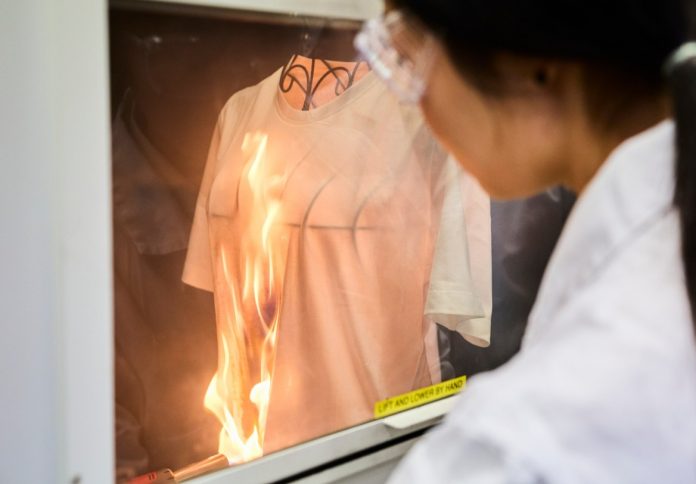
Engineers at UNSW Sydney have developed a spray designed to make cotton clothing and fabrics more resistant to fire, offering a potential new tool for people in bushfire-prone regions and emergency situations.
The water-based spray forms an almost invisible protective layer on cotton without affecting its softness or breathability, addressing a long-standing challenge in developing fire-resistant coatings for textiles, the university said in a news release.
The project was led by Professor Guan Yeoh from UNSW’s School of Mechanical and Manufacturing Engineering and was supported by a $5 million grant from the Australian government through the ARC Research Hub for Fire Resilience Infrastructure, Assets and Safety Advancements (FRIASA), based at UNSW.
“We chose cotton because it’s one of the most common materials used in the clothing and textile industry,” Prof Yeoh said.
“What we’ve achieved is a solution that doesn’t smell and doesn’t change the softness of the cotton once it’s sprayed on. So, the item of clothing still feels the same as before.”
The formula, developed by the UNSW research team, uses non-toxic compounds made from phosphorus, nitrogen, and a cellulose extract derived from plants such as cotton and wood pulp.
These elements combine to form a protective carbon layer that helps repel heat. Laboratory testing at UNSW showed that cotton treated with the spray took twice as long to ignite compared to untreated fabric, released half the heat, and showed an 89 per cent reduction in peak heat release rate.
“Our results also show that when exposed to heat, the surface temperatures on the textiles could be reduced to 30 to 40 per cent of the heat temperature,” Prof Yeoh said.
“In simulated fire environments, treated fabrics kept temperatures on the skin-side below 40 degrees Celsius, even when the external environment hit 100 degrees Celsius. That difference could prevent scalding or burns to the skin.”
UNSW researchers found that the spray’s protective layer can withstand light contact with water but dissolves in a rigorous wash, returning fabrics to their original flammability. Prof Yeoh said this highlighted how the spray serves as a temporary but effective fire safety measure.
“What we wanted to demonstrate was whether washing off the coating would return the fabric to its original flammability,” he said. “And it did, which shows that the coating provides that protective layer on your shirt or pants until you wash it off.”