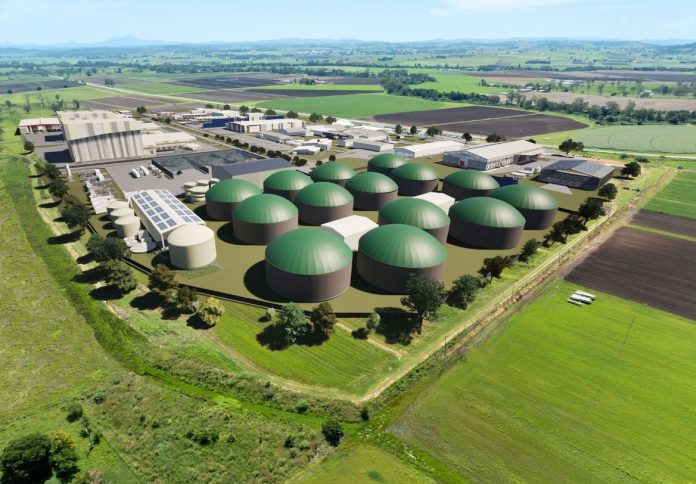
Queensland vegetable grower Kalfresh has secured an $80 million climate investment to advance a new manufacturing-focused food and energy development in regional Queensland, marking the start of construction on what is described as Australia’s first integrated paddock-to-power precinct.
In a media release, Kalfresh said the funding from Wollemi Capital and the Queensland Investment Corporation (QIC) will support development of the $291 million Scenic Rim Agricultural Industrial Precinct (SRAIP) at Kalbar.
The 40-hectare site will combine food manufacturing and renewable energy production, turning farm waste into renewable natural gas and biofertiliser.
At the centre of the precinct will be the Kalfresh Bioenergy Facility, which will use anaerobic digestion to convert food waste, crop residues and processing offcuts into renewable natural gas.
At full capacity, the facility is expected to generate enough energy to power up to 31,000 homes or fuel up to 98 million kilometres of truck, bus and tractor travel annually, while abating up to 430,000 tonnes of CO2 emissions each year.
Queensland Deputy Premier and Minister for State Development, Infrastructure and Planning Jarrod Bleijie said the project demonstrated how industry and innovation could work together to support economic growth.
“Queensland is open for business, and we’re working with the private sector on strategic partnerships like this that will accelerate development and drive innovation in our priority industries, and create secure new jobs,” Bleijie said.
Minister for Finance, Trade, Employment and Training Ros Bates said bioenergy projects located in farming communities represented practical investment for regional areas.
“We are focused on strengthening Queensland’s economy and making sure regional communities share in that growth,” Bates said.
“That’s how you build a stronger economy, by backing industry, working with farmers and making sure projects stack up economically as well as environmentally.”
Kalfresh co-owner and Chief Executive Officer Richard Gorman said the technology underpinning the project was proven internationally and would provide multiple renewable energy and manufacturing outputs.
“This is a practical and proven renewable energy system that gives us so many options,” Gorman said. “We can produce renewable gas to fuel vehicles and power homes and industry with farm waste inputs.”
He said anaerobic digestion is a natural process in which microbes break down organic matter to produce gas, with the remaining digestate used as a natural fertiliser. “It’s a closed loop system that returns many benefits. It reduces emissions, supports farmers, decarbonises industry and transport, and boosts local skilled jobs,” he said.
Wollemi Capital Co-Founder and Co-CEO Tim Bishop described the project as “shovel-ready climate infrastructure”, adding that the model demonstrated how agriculture and renewable energy could operate together at scale. QIC CEO Kylie Rampa said the investment represented a significant step in demonstrating the commercial viability and scalability of bioenergy from the paddock up.
“Bioenergy is a proven, reliable technology used around the world, and Kalfresh has brought forward a practical vision for Australia’s first scaled deployment designed specifically for Queensland conditions,” Ms Rampa said.
According to Kalfresh, anaerobic digestion has been used in Europe and the United States for decades, including to power homes, industry and transport fleets.
The company said this project would be the first scaled deployment of the system in an Australian farming region tailored to Queensland conditions.
Construction of the Queensland Government Coordinated Project has commenced, with first clean energy production scheduled for mid-2027. Kalfresh said the precinct is expected to generate around 1,000 jobs during construction and operation, including up to 475 permanent roles.
Kalfresh founding director and co-owner Robert Hinrichsen said the company plans to expand operations within the Cunningham Highway precinct and offer 13 serviced lots to third-party food and beverage manufacturers, providing access to on-site renewable power and circular waste services.
“We’re confident our Kalbar project is just the start for this farm to fuel model,” Hinrichsen said. “It brings new investment to regional areas, develops new markets for agriculture and creates secure, year-round skilled local jobs.”
Kalfresh was advised by Deloitte Corporate Finance and Talbot Sayer, while Wollemi and QIC were advised by HSF Kramer.