Australian manufacturing has outperformed broader industry growth for two consecutive years, reversing a decades-long trend of below-average expansion, according to Export Finance Australia (EFA).
EFA said the share of manufacturing in the Australian economy increased to 7.34% in 2025, up from a multi-decade low of 7.19% in 2023. The sector has also maintained its recent momentum into 2026, with manufacturing output rising 3.2% year-on-year in the first quarter, compared with national GDP growth of 2.5%.
The increase contributed 0.1 percentage points to overall economic growth during the quarter, EFA said.
Food products manufacturing, which accounts for 22% of the manufacturing sector, was the largest contributor to recent growth, expanding by 8% year-on-year in 2025. EFA said food manufacturing had remained a consistent area of strength, recording average annual growth of 7% over the past five years.
Other manufacturing segments also recorded growth in 2025, including fabricated metals, which represents 11% of the sector and grew 7%, and chemicals, which accounts for 8% and increased 11%. Transport equipment manufacturing, representing 10% of the sector, grew 7%, while machinery and equipment manufacturing, which makes up 14%, increased 4%.
EFA said manufacturers were increasingly looking to overseas markets for further growth as Australian producers meet domestic demand.
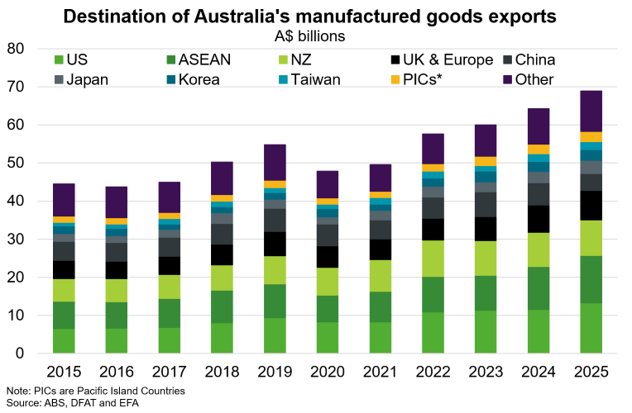
Australian manufactured goods exports have risen steadily in recent years, with the United States remaining the largest destination for manufactured goods. However, EFA said export growth over the past five years had been strongest in India, Taiwan, Japan and ASEAN markets.
The export outlook is also being shaped by changes in US trade policy. EFA said the US introduced Section 301 forced labour tariffs on Australia in July, applying a 12.5% tariff to Australian goods and tariffs ranging from 10% to 12.5% to goods from 59 other economies.
The tariffs replaced the 10% Section 122 Temporary Import Surcharge introduced in February, following a US Supreme Court ruling against the earlier tariffs imposed under the so-called Liberation Day measures in April 2025.
EFA noted that the tariff treatment varies across economies, with some countries facing additional tariffs beyond the Section 301 measures. Despite the changes, the agency said 70% of Australian exports to the US continued to enter duty-free.
The latest manufacturing performance therefore comes alongside ongoing external pressures, particularly for businesses seeking to expand through international markets.
This article contains information provided by Export Finance Australia (EFA) and is intended for general use only. It does not take into account your personal, professional, or business circumstances. Please consult a licensed and/or registered professional in this area before making any decisions based on the content of this article.