For generations, battery storage efficiency has been dictated by a hidden limitation: the performance of its weakest cell. In traditional designs, interconnected cells create a vulnerability where a single underperforming component compromises the entire pack’s output.
Melbourne-based technology company Relectrify saw this constraint and set out on a mission to address it, specifically focusing on giving second-life electric vehicle batteries a new purpose and improved performance.
Relectrify’s solution comes in the form of its patented CellSwitch technology, which independently controls and optimises each battery cell rather than treating them as a uniform string.
CEO Jeff Renaud detailed the underlying mechanics of the technology in an exclusive interview with Australian Manufacturing.
According to him, this approach allows the system to selectively activate cells based on their real-time condition. This eliminates the “weakest-link problem at its source,” while increasing usable energy in every cycle and extending operational lifespan.
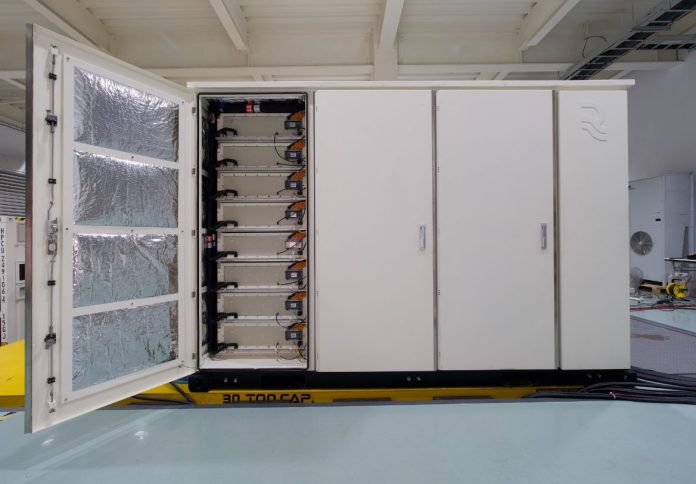
In October 2025, Relectrify received $25 million in funding from the Australian Renewable Energy Agency (ARENA) to support the launch of its AC1 battery energy storage system (BESS).
The AC1 represents Relectrify’s first volume product to commercialise the CellSwitch technology. The company combines its cell-level management system with new lithium-iron-phosphate (LFP) cells to create a fully software-defined battery solution.
“The result is a battery system that delivers higher energy yield, longer operating life, improved safety, and greater robustness — translating directly into higher returns and a lower levelised cost of energy,” Renaud said.
What’s in it for Australian manufacturers?
According to Renaud, the technology offers particular advantages for Australian manufacturers facing rising electricity costs.
“Manufacturers with power-intensive processes are uniquely positioned to benefit from battery storage. By reducing peak demand charges and shifting energy consumption to lower-cost wholesale pricing periods, storage can deliver immediate and measurable cost savings,” the tech company exec said.
Renaud further explained that the system is designed to capture value from both demand reduction and energy arbitrage.
“As a general rule, the greater a site’s power demand during peak periods — typically between 3 pm and 9 pm — the larger the savings opportunity. While outcomes vary by state and individual load profile, sites with high and predictable peak demand stand to see the strongest financial returns.”
Renaud also points to mounting pressures on industrial operations beyond just cost concerns.
“Industrial energy users are under increasing pressure from rising electricity costs and demand charges, while also being asked to decarbonise their operations. Battery storage enables them to actively manage energy use, unlock more value from on-site solar, and reduce emissions — all without requiring costly upgrades to the poles-and-wires network.”
Relectrify has developed the system with mid-sized operations in mind, specifically manufacturers operating in the 200 kW to 5 MW range. This segment, according to the company’s CEO, represents the scale at which storage transforms from being a technical option to delivering clear financial returns.
“With lower integration effort, reduced operational risk, and stronger lifetime returns, AC1 turns energy storage from a complex engineering project into a straightforward financial decision,” he said.
Is there anything adopters of the technology should know?
The AC1 BESS launch includes an ARENA subsidy available to early adopters, though it is limited to the first 100 MWh of deployed capacity, Renaud noted.
The company states it will manage subsidy application and compliance processes for customers, with installations scheduled to commence from May 2026. The typical timeline from order to operational system is three to four months, encompassing delivery, installation, and commissioning.
For businesses interested in the technology, registration is open for those wanting to be among the first to deploy the system at www.relectrify.com/au/commercial-enquiries.