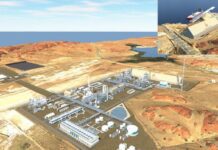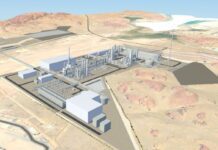
Indian engineering and manufacturing company Larsen & Toubro (L&T) has completed the fabrication and delivery of 110 modules weighing about 64,000 metric tonnes for Project CERES, a 2.3 million-tonne-per-annum urea manufacturing plant being developed in Karratha, Western Australia.
In a news release, L&T said the project is being developed by Perdaman Chemicals & Fertilisers under the Saipem-Clough Joint Venture, with L&T’s scope covering 47 pre-assembled units and 63 pre-assembled racks.
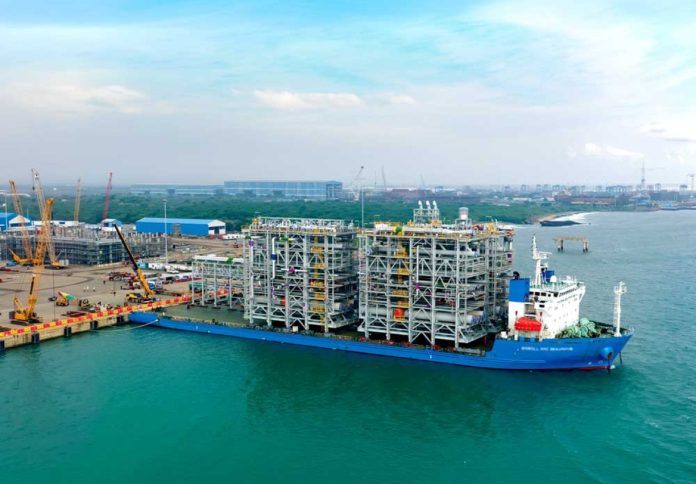
The modules were fabricated at L&T’s Modular Fabrication Facility at Kattupalli near Chennai and shipped to Karratha across 23 marine shipments in tested, pre-commissioned and ready-to-install condition.
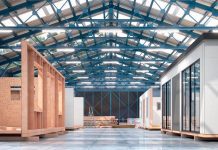
According to L&T, the project demonstrates how manufacturing and other project activities can be undertaken away from the final construction site, with fabrication, equipment installation, integration, testing and pre-commissioning completed in a controlled environment in India.
“Project CERES reflects how L&T is elevating India’s role in the global project-delivery ecosystem, from a manufacturing base to a source of integrated engineering, technology and execution capabilities,” L&T Chairman and Managing Director S N Subrahmanyan said.
“Delivering modular fabrication of this scale, with an excellent safety record, for Australia, demonstrates the depth of India’s industrial ecosystem and its ability to meet demanding international standards,” he said.
L&T said the project achieved 37 million safe workhours and met Australian biosecurity and Electrical Equipment in Hazardous Areas requirements. Dimensional, quality and interface controls were also applied to support integration of the modules at the Karratha site.
Some of the complex equipment incorporated into the modules was manufactured at L&T’s advanced manufacturing facility at Hazira in Gujarat.
L&T Deputy Managing Director and President Subramanian Sarma said modularisation allows construction, integration, testing and pre-commissioning activities to be moved from project sites to fabrication facilities.
“By shifting substantial construction, integration, testing and pre-commissioning activities from the project site to a controlled fabrication environment, it enables parallel execution, strengthens safety and quality oversight, improves predictability and reduces complexity at site,” Sarma said.
L&T said its Kattupalli facility, which spans 900,000 square metres and has annual fabrication capacity exceeding 70,000 metric tonnes, includes dedicated marine load-out infrastructure.
The company said the modular fabrication approach could also be applied to projects in sectors including LNG, gas processing, refining, petrochemicals, chemicals, hydrogen and low-carbon fuels, particularly where remote locations and construction constraints are factors.