Five doctoral students have presented their research as potential commercial ventures in what the Australian Composites Manufacturing Cooperative Research Centre (ACM CRC) described as a nation-first pitching competition.
The competition was held during ACM CRC’s annual Partner Meeting 2026, giving PhD candidates an opportunity to consider the commercial potential, market opportunity and economic impact of their research alongside its technical aspects.
ACM CRC Research Portfolio Manager Dr Puneet Garg, who led the initiative, said researchers involved in CRC-funded projects needed to consider more than the scientific dimensions of their work.
“When you’re engaged in an R&D project funded by CRC – which promotes collaboration and helps solve industry problems through research – it becomes important to understand your PhD not just from a research point of view, but also from a commercial and economic impact point of view,” Garg said.
He said the initiative was, to the organisation’s knowledge, the first of its kind coordinated through a CRC in the program’s 36-year history.
The finalists were assessed on innovation and technical credibility, commercial potential and market opportunity, alignment with national priorities, economic impact and pitch delivery. At the Partner Meeting, attendees voted for their preferred pitches, with each vote representing $25,000 in investment.
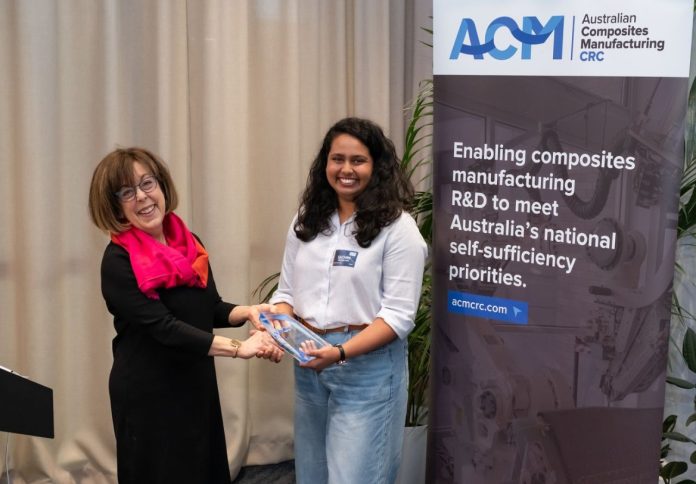
Deakin University’s Sachini Dissanayake took first place with a pitch based on her research into chemical bonds and their potential application in self-healing coatings for infrastructure.
Her proposed business, HEALCOAT, was based on research into a novel material and its properties. Dissanayake estimated that capturing 1 per cent of Australia’s $3.9 billion coatings market could represent $39 million in value. Her pitch received about $500,000 in backing through the audience vote.
“I saw the numbers and it actually motivated me more knowing, ‘Oh, this is a market that I can address too,’” Dissanayake said.
Runner-up Sriram Ravishankar Padma, a University of Western Australia student working with industry partner Fuze, presented BONDSIGHT, an enterprise concept based on research into resistance and strain contour correlation for structural health monitoring.
Padma identified a potential global composite repairs market of US$22.8 billion by 2031 and a local serviceable addressable market of $216 million by 2030. His proposed model focused on selling a qualified technology incorporating procedures, sensor layouts and detection and prediction algorithms rather than the sensors themselves.
“I am not selling the sensors here, but the commodity for sale is a qualified technology,” Padma said.
Stephen Joseph from The University of Queensland placed third with research into material systems and coatings for high-temperature composites. He positioned the technology as an enabling component rather than a finished product, suggesting licensing could be one potential commercial pathway.
“Once you think about your markets and your customers, my technology isn’t the product: my technology is an enabler to the product,” Joseph said.
The other finalists included University of Southern Queensland researcher Neda Bozorgi, who identified potential opportunities for bio-based glass fibre-reinforced polymer structural reinforcements, and UWA’s Jingjing Sun, whose Repairworks concept uses a software-as-a-service model to support data-driven decisions around composite repair of ageing infrastructure.
Garg said the competition showed that some PhD researchers already had commercial skills, while others could use the format to develop them.
“Once you finish your PhD, whether you go on to work in industry or academia, commercial know-how of the technologies being developed becomes really important,” he said.
He added that understanding concepts such as Technology Readiness Level and Commercial Readiness Level could benefit researchers even when a detailed market plan was not required.
“We also look forward to seeing new Australian companies emerge from PhD-discovered technology,” Garg said.