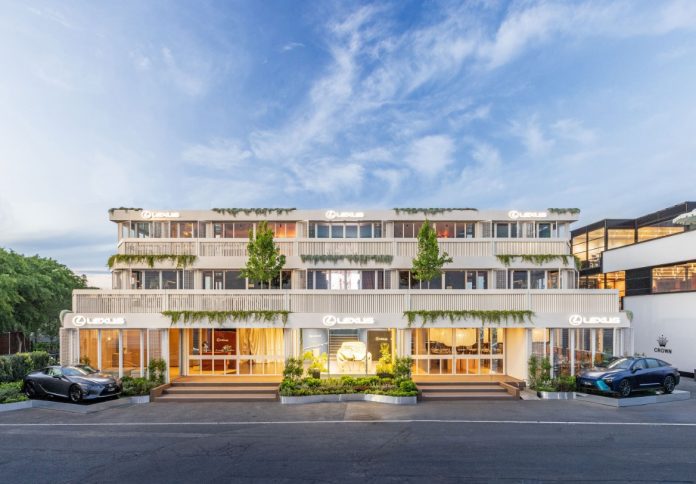
Spacecube, a Melbourne-based modular construction company, has announced that its modular building system was used to construct 80 per cent of the structures in this year’s Melbourne Cup Carnival Birdcage enclosure.
In a news release, the company said its technology is reshaping event infrastructure by providing faster, more sustainable alternatives to traditional marquees.
According to Spacecube, its flat-pack, precision-engineered modular system allows event organisers to create premium structures that can be reused and reconfigured across multiple events, reducing waste and improving installation efficiency.
Event partners including Kirin, Tabcorp, G.H. Mumm, Channel Nine and Lexus incorporated Spacecube’s building system into their pavilions this year.
The company said this approach enabled brands to present sophisticated, architecturally designed spaces while supporting sustainability objectives.
“Redefining event infrastructure across the globe, our patented modular system can be reused, reconfigured and redeployed,” said Mark Davies, CEO of Spacecube.
“Functioning as a circular asset model, clients can cut waste, accelerate installation cycles and trust their customised Spacecube will perform like a permanent structure with fully integrated services.”
Spacecube stated that its reusable modules demonstrate how Modern Methods of Construction (MMC) can help reduce waste by up to 60 per cent. The company added that this approach is driving increasing global interest in modular systems that combine speed, scalability and circular design principles.
The company said its international expansion has been supported by demand for such infrastructure, with Spacecube modules reportedly being used at major global events, including Formula 1 circuits in Australia, the UK, Europe and the US, as well as the Eurovision Song Contest, Royal Ascot, Royal Randwick, the Paris Olympics, and US College Football and Premier League Soccer fixtures.
Since debuting at the Birdcage in 2014, Spacecube said it has grown from a three-person start-up to a global team of 80.
The company attributed this growth to its partnerships with event agencies and developers seeking high-performance modular systems that combine the aesthetics of permanent structures with the flexibility of temporary builds.
Strategic investment from Taronga Ventures and new licensing and distribution agreements in North America and Europe have also supported Spacecube’s scaling efforts, with the company noting that these partnerships have enhanced its ability to maintain design quality, engineering precision and delivery reliability worldwide.
“The world needs infrastructure that can move, adapt and perform with less impact — and we are proud to be an Australian-owned platform that is leading the way and resetting the global benchmark,” Davies said.