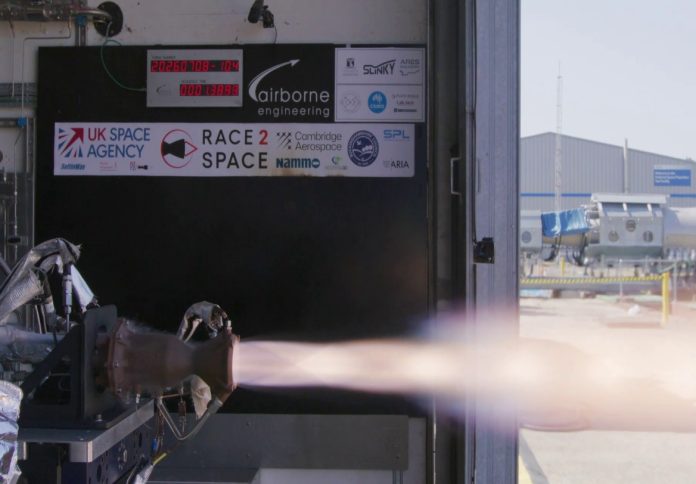
Australian manufacturing innovation has helped a team of University of Melbourne students test-fire a 3D-printed rocket engine at an international competition, marking what CSIRO says is a first for an Australian student team at Race2Space.
The rocket engine, dubbed Slinky, was developed by students from the University of Melbourne with support from CSIRO’s Lab22, the national science agency’s centre for additive manufacturing innovation.
According to CSIRO, the project is the first regeneratively cooled liquid rocket engine successfully fired by an Australian student team at Race2Space, one of the world’s leading student rocketry competitions.
The engine was created as part of a University of Melbourne Aerospace and Rocket Engineering Society (ARES) capstone project by master’s students Jack Gardiner, Brooke Doolan and Stuart Davis, working alongside researchers and engineers from Lab22.
CSIRO senior research scientist and Lab22 team leader Dr Cherry Chen said additive manufacturing enabled the team to incorporate internal cooling channels directly into the combustion chamber wall, replacing the complex network of external pipes traditionally used to cool rocket engines.
“Now using 3D printing, we can build channels inside the combustion chamber wall, which improve the cooling efficiency,” Dr Chen said.
She said the project demonstrated how advanced metal additive manufacturing could enable complex designs that conventional manufacturing methods cannot achieve.
“Lab22 provided expert guidance on material selection, mechanical behaviour and design for additive manufacturing, and post-treatment of 3D printed parts, enabling the team to optimise the engine for high performance operation,” Dr Chen said.
The engine was manufactured at Lab22’s Clayton facility using a Nikon SLM Solutions 280 2MA laser powder bed fusion system to produce the component in a copper alloy selected for its thermal conductivity and suitability for high-temperature environments.
The team transported the approximately 6kg engine to the United Kingdom earlier this month to compete at Race2Space, where it completed five stable hot-fire tests, including throttling runs, and achieved a maximum thrust of 5.4 kilonewtons.
Team member Stuart Davis said the results secured first place in the competition’s liquid oxygen (LOX) bipropellant category.
“We’re absolutely thrilled to be at the cutting edge of computational engineering and demonstrating the results that its integration can achieve,” Mr Davis said.
University of Melbourne Chair and Professor of Computational Mechanics Richard Sandberg, who supervised the capstone project, said the achievement highlighted the value of combining computer-assisted design with additive manufacturing.
“This rapid concept-to-test approach will speed up development cycles in engineering, helping to innovate and bring down cost,” Professor Sandberg said.
He added that collaborations with organisations such as CSIRO’s Lab22 help provide students with opportunities to develop advanced engineering skills and contribute to Australia’s future aerospace capability.
Dr Chen said the project also demonstrated the potential of additive manufacturing to support next-generation aerospace development and sovereign capability in high-performance propulsion systems.
“We are incredibly proud of Jack, Brooke, and Stuart for pushing boundaries and demonstrating what Australian engineering talent can accomplish,” she said.
Team member Brooke Doolan said the successful testing represented “a big step forward for ARES Rocketry”.
“It opens the door to more complex propulsion design and manufacturing, with hopes to integrate Slinky into a future rocket and drive the next generation of propulsion development at the university,” Ms Doolan said.