Engineers at The University of Queensland (UQ) have developed a floating wind turbine design they say could reduce the cost of offshore wind structures by 40 per cent.
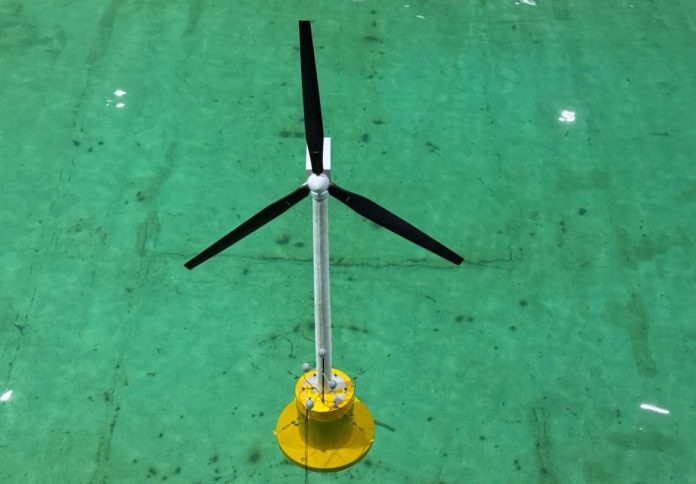
UQ Associate Professor Wenhua Zhao has tested a scale model designed to support a 3.6-megawatt turbine, with an 87-metre tower and blades spanning 120 metres in diameter. The proposed structure is designed to operate in water depths of up to 200 metres.
According to UQ, floating offshore wind turbines can access stronger and more consistent winds in deeper waters, expanding the areas available for renewable energy generation. However, their adoption has been constrained by the cost of complex floating substructures and anchoring systems.
“The issue is not about whether floating turbines work, or whether they offer benefits for shipbuilders, resources companies, or aquaculture,” Dr Zhao said.
“The issue is the price. Floating turbines are currently about twice as expensive as turbines fixed in shallow waters, and almost four times the cost of land-based turbines.”
Dr Zhao and colleagues at UQ’s School of Civil Engineering used geometry based on offshore hydrodynamics principles to develop the scale model. UQ said the design uses conventional marine construction materials and internal stabilisation features to reduce costs and improve stability.
“Using conventional marine construction materials in a cost-conscious configuration allowed us to significantly reduce costs,” Dr Zhao said.
Deep-ocean and extreme-weather simulations indicated the design could withstand a one-in-100-year storm and operate in waters up to 200 metres deep, compared with the reported 50 to 60-metre depth limit for fixed offshore turbines.
Further testing at a wave basin facility at Shanghai Jiao Tong University in China provided additional validation of the design, according to UQ.
Dr Zhao said the technology could be ready for commercial adaptation or implementation within two years, while work with industry partners is also examining smaller versions for niche offshore applications.
“We see tremendous potential for this technology to be adopted across Australian offshore industries,” he said.
“It could provide clean, reliable power for offshore operations, the decommissioning of ageing offshore platforms, emerging offshore aquaculture, and future deep-sea data centres.”