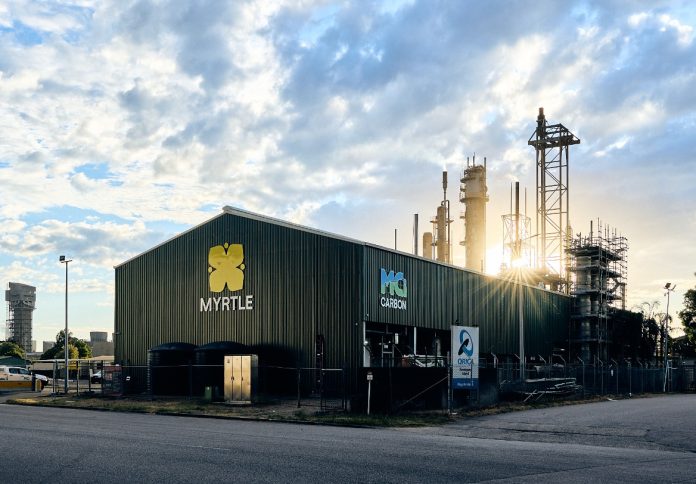
Australia’s manufacturing sector has been placed at the centre of a new industrial decarbonisation push with the opening of what MCi Carbon says a world-first carbon refinery in Newcastle, a facility designed to convert carbon emissions into materials used in everyday manufacturing.
The Australian clean technology company MCi Carbon has officially opened “Myrtle”, a multi-purpose carbon refinery on Kooragang Island in Newcastle, in a milestone it says could reshape emissions-intensive manufacturing globally. The launch was officiated by Australia’s Minister for Climate Change and Energy Chris Bowen.
MCi Carbon said Myrtle is built on 15 years of Australian research and development and uses mineral carbonation to transform CO? and low-value mineral feedstocks into carbon-embodied materials used in products such as concrete, plasterboard, paint, paper, glass and adhesives.
The company said the approach permanently locks carbon into materials already used across global supply chains.
MCi Carbon founder and chief executive Marcus Dawe said the technology gives heavy industry a commercial route to reduce emissions while generating revenue.
“Heavy industry now has a commercial pathway to decarbonise – and profit while doing so,” Dawe said.
“By transforming CO? and low-value mineral feedstocks into carbon-embodied materials that cement, steel, plastics, glass and construction industries already buy, MCi Carbon’s mineral carbonation platform reframes decarbonisation as an investment with a return, not a cost to be managed.”
He said the facility is designed as a validation platform for industrial partners. “Myrtle is open. Our invitation to the leaders of hard-to-abate industry is simple: send us your CO? profile and your feedstocks. We’ll run a rapid validation and hand back the technical, product and commercial data you need.”
Minister Bowen said the project demonstrates how regional industrial centres could play a role in the transition to lower-emissions manufacturing.
“We’re backing Australian innovation to cut emissions and create the next generation of clean industries,” Bowen said.
“This demonstration plant is a glimpse of what could become a major new industry for places like Newcastle and the Hunter… This is about cutting emissions, creating new products, and building new clean industries, literally brick by brick.”
MCi Carbon said the technology can reduce emissions in hard-to-abate sectors by up to 90 per cent, depending on application, and positions decarbonisation as an investment opportunity rather than a compliance cost. It also said the global market for carbon-embedded construction materials could reach USD $1 trillion annually by 2050.
The company said Myrtle can process up to 2,500 tonnes of CO? per year and produce up to 10,000 tonnes of saleable materials, with outputs intended for use in existing manufacturing and construction supply chains. It said the platform is designed to scale to hundreds of thousands of tonnes of CO? annually.
Industrial backing for the project includes founding investor Orica, along with international partners such as ITOCHU Corporation, Mizuho Bank, Sumitomo Mitsui Trust Bank, and Mitsubishi UBE Cement Corporation. MCi Carbon’s first commercial customer is RHI Magnesita, which has invested in the technology and is targeting a commercial plant by 2030.
MCi Carbon chief operating officer Sophia Hamblin Wang said the facility demonstrates that carbon can be turned into a manufacturing input.
“We’ve spent more than a decade proving that carbon dioxide doesn’t have to be a problem, it can be a building block,” Ms Hamblin Wang said. “This isn’t a climate technology that needs a carbon price to work. The business model stands on its own.”
She said early trials of materials produced at Myrtle have already been tested in concrete applications with Australian industry partners, including Boral, in research programs involving Transport for NSW and the University of Technology Sydney.
MCi Carbon said mineral carbonation permanently locks CO? into stable mineral compounds, producing no waste and requiring no long-term monitoring. The company said the technology is being positioned for deployment either directly at industrial sites or through centralised hub-and-spoke facilities.
The company estimates the facility could support up to 50 skilled jobs at full operation and said the broader platform could create new roles across manufacturing, cement, steel and chemicals sectors as they transition.
MCi Carbon said the Myrtle project has also received more than AUD $40 million in government support across federal and New South Wales programs.