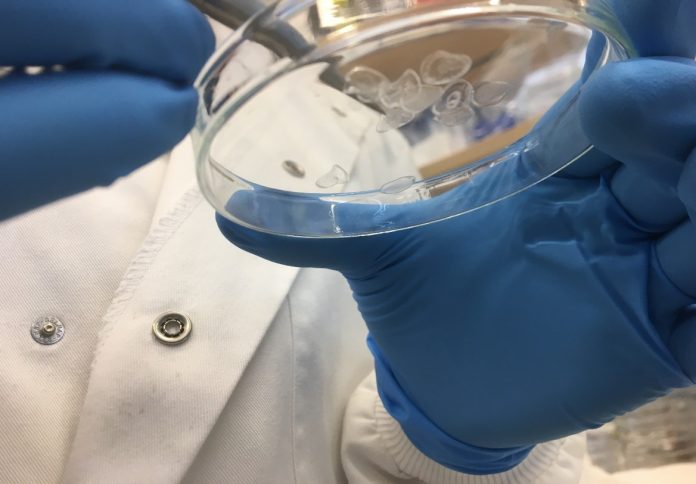
Researchers from CSIRO and Adelaide University are investigating engineered honeybee silk as a potential material for a new generation of smart wound dressings.
The research, published in the Journal of Biomedical Materials Research Part B: Applied Biomaterials, found that biodegradable films made from recombinant honeybee silk were safe and well tolerated during wound healing.
The researchers also found that much of the silk film gradually broke down in the wound, rather than remaining as a permanent material. CSIRO said this could potentially reduce the need to remove dressings and disturb newly formed tissue during healing.
“Think of the film as a building material that we can redesign at the molecular level,” said Dr Caitlin Johnston, lead researcher at CSIRO.
“We can potentially build specific instructions into the silk so that, in the future, a dressing could respond to the conditions in a wound rather than act as a passive barrier.”
Unlike silkworm or spider silk, honeybee silk is a protein material produced by honeybee larvae to form protective structures in the hive. According to CSIRO, its protein sequence can be modified while maintaining the material’s structure, allowing researchers to investigate features such as infection sensing and targeted drug release.
Dr Anna Antipov of Adelaide University’s Future Industries Institute said understanding how the material behaves during wound healing was an important step before introducing additional functions.
“Wound healing is a very complicated process, and we need to understand how a new material behaves in that environment before we can start adding more sophisticated functions to it,” Antipov said.
The research builds on more than a decade of CSIRO work developing honeybee silk as a biomaterial platform. The organisation said previous studies have found the material to be strong, flexible, biodegradable and suitable for biological applications.
The team has now received a Medical Research Future Fund grant to develop and test several smart dressings aimed at helping prevent infections in chronic wounds.
CSIRO said chronic wounds affect an estimated 450,000 people in Australia each year and cost the health system more than $6 billion annually. The organisation noted that infections can delay healing and may increase the risk of hospitalisation and amputation.
For the current research, CSIRO developed and produced the recombinant honeybee silk film, while Adelaide University provided wound-healing expertise and conducted laboratory testing.