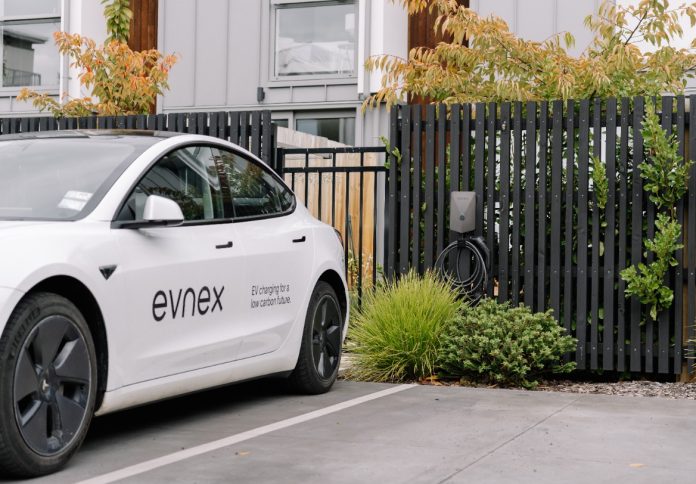
Evnex has passed 20,000 electric vehicle (EV) chargers installed across Australia and New Zealand, with the smart charger manufacturer reporting a sharp acceleration in demand from the Australian market.
In a news release, the company said its first 10,000 chargers took eight years to install, while the second 10,000 were installed in nine months.
Evnex now sells about twice as many chargers in Australia as in New Zealand, with the number of chargers operating in each country reaching parity this month.
The milestone comes as EV sales increase in Australia. According to Evnex, more than one in five new vehicles delivered in July were battery electric vehicles (BEVs), while 127,244 BEVs had been delivered in Australia so far this year.
“When we started out, an EV was a rare sight on either side of the Tasman,” said Ed Harvey, founder and CEO of Evnex.
“Now more than one in five new cars sold in Australia is fully electric. Home charging is moving from an early-adopter product to mainstream household infrastructure.”
Evnex said its chargers have delivered more than 75 GWh of electricity to EVs in Australia and New Zealand since its first delivery. The company estimates this has powered around 450 million kilometres of driving and displaced more than 30 million litres of petrol.
The company said the growth of rooftop solar, home batteries and flexible electricity tariffs is also changing how EV charging can be managed at home.
“Our answer has always been smart charging, so it happens overnight or when the sun’s out, when power is cheaper and renewables are abundant,” Harvey said.
Evnex has partnered with EnergyAustralia on solar-smart charging and launched its E2 Flex charger for Australian homes without rooftop solar. The company said the charger can initially operate using grid electricity and later support solar integration through a software update.
The company currently employs 48 people across Australia and New Zealand, while its chargers continue to be designed and built in Christchurch.
“The next 20,000 will come a lot faster than the first,” Harvey said. “We have had spikes before, but this one feels structurally different.”
He said the company’s modelling indicates Australia is entering the early stages of mass EV adoption, while describing the home charger as increasingly connected to the broader household energy system.