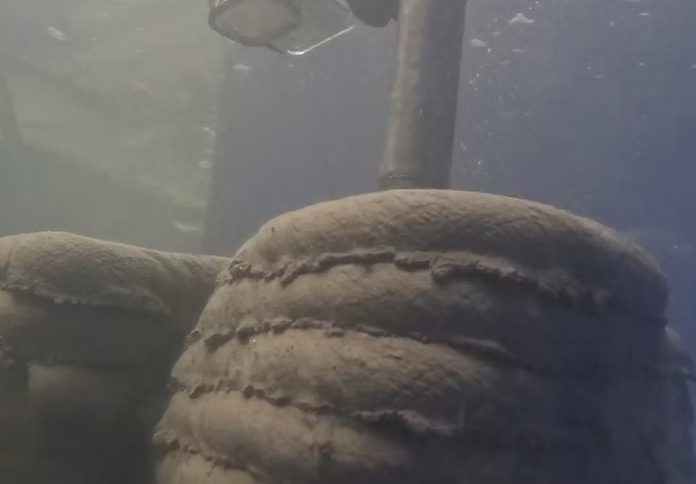
Australian manufacturing company LUYTEN 3D, in collaboration with researchers from the University of Wollongong (UOW), has unveiled what they describe as Australia’s first submerged 3D concrete printing system alongside a world-first accelerator-free underwater concrete formulation.
According to LUYTEN 3D and UOW, the development centres on a “single-mix” concrete designed to remain stable and buildable underwater without the need for chemical accelerators, marking a departure from conventional marine construction methods that typically rely on staged or chemically assisted processes.
In an exclusive interview with Australian Manufacturing, LUYTEN 3D co-founder and chief executive Ahmed Mahil said the project required addressing multiple constraints that have traditionally limited underwater construction applications.
Mahil said underwater additive manufacturing had long been constrained by a combination of physical and engineering challenges.
“Underwater additive manufacturing presents three core constraints: hydrostatic pressure, material washout, and robotic stability in a fluid environment,” Mahil said.
“The breakthrough was not a single invention, but the integration of material rheology, robotic control, and deployment architecture into one coherent system.”
He said traditional concrete tends to disperse when placed underwater, while robotic systems must contend with reduced visibility, resistance, and positional instability. The collaboration with UOW, he said, focused on addressing these issues simultaneously through coordinated material and systems engineering.
Shift toward digital fabrication
LUYTEN 3D said the accelerator-free formulation could significantly alter established workflows in marine construction, where conventional approaches often rely on cofferdams, prefabricated components, and chemical setting agents.
Mahil said the system simplifies those processes by enabling direct, on-site extrusion of concrete structures underwater.
“It allows reduced staging infrastructure, fewer chemical dependencies, and greater process predictability,” he said. “In manufacturing terms, it moves underwater construction from a reactive containment model to a controlled digital fabrication model.”
The company and UOW researchers said the approach extends additive manufacturing techniques into subsea environments that have historically required complex, resource-intensive engineering solutions.
Implications for defence and infrastructure
LUYTEN 3D and UOW indicated the technology is being assessed for potential use across defence, ports, offshore energy, and coastal infrastructure applications, including submerged structures and repair works.
Mahil said the ability to manufacture directly underwater could reshape how large-scale marine infrastructure is delivered.
“We will see a shift from transporting large prefabricated marine components toward digital, on-demand, in-situ fabrication,” he said.
He added that such an approach could potentially reduce repair timelines, lower reliance on dry-docking, and improve operational continuity for critical maritime infrastructure.
Commercial readiness and scalability
LUYTEN 3D said the system has progressed beyond laboratory validation and is now in a controlled demonstration phase, with engagement underway with regulators and stakeholders in the defence and ports sectors.
Mahil said scalability would not be a limiting factor for the technology, pointing to the company’s existing large-scale additive manufacturing capability.
“Scalability is not a constraint,” he said. “Commercial pilots are the logical next step.”
Supply chain and efficiency considerations
The company also said the technology could have broader implications for supply chain efficiency in marine construction by enabling more localised, on-site production.
Mahil said reducing reliance on transported prefabricated components could lower logistics complexity and associated emissions.
“Efficiency in additive manufacturing is not just about material savings—it is about compressing complexity,” he said.
Broader applications in extreme environments
Beyond marine infrastructure, LUYTEN 3D and UOW suggested the research may have applications in other extreme or remote environments where traditional construction methods are constrained.
Mahil said systems designed for underwater deployment could inform broader manufacturing approaches in challenging settings.
“Extreme environments reward systems that are self-contained, modular, and digitally controlled,” he said, pointing to potential applications in disaster response, remote infrastructure development, and future space-related construction concepts.
This article contains information provided by LUYTEN 3D and is intended for general use only. It does not take into account your personal, professional, or business circumstances.