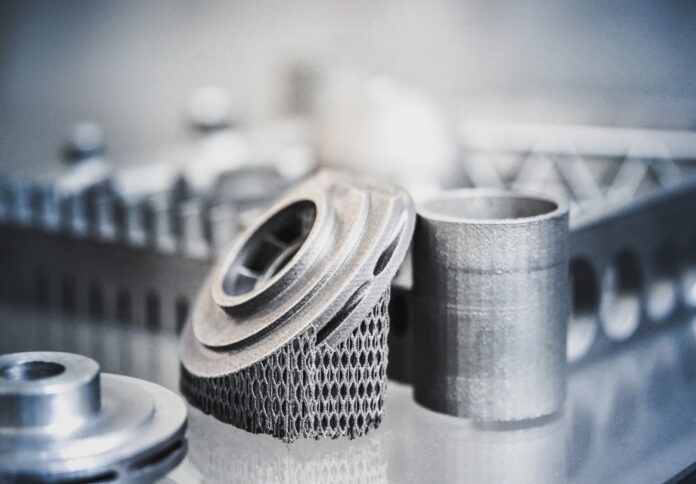
A new manufacturing project led by Charles Darwin University aims to use high-speed 3D printing to produce naval propulsion components made from nickel aluminium bronze (NAB), a material the university says is difficult and slow to manufacture using traditional methods in Australia.
The project, supported by funding from the Queensland Defence Sciences Alliance, will test 3D-printed NAB parts in tropical seawater conditions and involves collaboration between James Cook University, the Australian Institute of Marine Science, and advanced manufacturing company SPEE3D.
CDU said NAB is widely used in marine and defence applications, including propellers, pumps, valves and bearings, due to its strength, toughness and corrosion resistance. However, the university noted that conventional manufacturing of NAB alloys is no longer viable in Australia.
The project will instead use SPEE3D’s cold spray manufacturing technology to produce NAB parts, which will then undergo testing to assess how they perform in seawater environments.
CDU Research Professor Kannnoorpatti Krishnan said the work addresses a need for reliable materials in naval propulsion systems for the Australian Defence Force.
“This reduces downtime, strengthens resilience in forward operating bases, and ensures continued operational effectiveness in contested maritime environments,” Professor Krishnan said.
He said the project also aimed to improve understanding of how materials behave in Pacific tropical waters.
“The project also secures a strategic advantage by generating new knowledge of material behaviour in Pacific tropical waters, where microbial communities are unique and largely unstudied,” he said.
On the manufacturing approach, he said the collaboration was designed to strengthen local capability.
“In terms of sovereign industry capability, the project builds a uniquely Australian supply chain by combining SPEE3D’s deployable additive manufacturing platform with academic expertise in materials, chemistry, and marine science,” he said.
QDSA Director Stuart Blackwell said the initiative supported new approaches to maritime logistics and sustainment.
“The focus on innovative littoral capabilities is highly relevant to marine applications across northern Australia and beyond,” Blackwell said.
“This new approach to manufacturing maritime parts closer to the point of need, in an on-demand environment, represents a step change in the future of logistics and sustainment.”
SPEE3D co-founder and chief technology officer Steven Camilleri said the company’s process could help address supply-chain risks associated with NAB.
“We see enormous potential for cold spray additive manufacturing to address repair, maintenance and sustainment challenges in Pacific maritime environments,” Camilleri said.
“If NAB can be printed with a demonstrated equivalence to qualified cast material, the opportunity is far more than novelty.”
He said it could improve availability of critical components.
“It represents the recovery of a strategically important maritime alloy; one that, when produced using additive manufacturing techniques, means parts will become more readily available through a faster, more local, and more controllable production route.”
JCU Distinguished Professor Peter Junk said the university’s role would focus on analysis of alloy composition and performance.
“Our team will assist with using surface techniques to understand the microstructure of the alloys and aged samples after field trials,” Professor Junk said.
He said testing would also assess corrosion performance under simulated marine conditions.
“We will also work on characterising the corrosion performance of the various NAB alloys under variable simulated seawater conditions, to be conducted at the Australian Institute of Marine Science in their seawater simulator than can modify pH, salinity, temperature and flow.”
Australian Institute of Marine Science National Sea Simulator Director Craig Humphrey said the facility would support controlled environmental testing.
“SeaSim is purpose-built to support complex multifactorial research in a controlled, aquarium-based environment,” Humphrey said.
CDU Deputy Vice-Chancellor Research and Community Connection Professor Steve Rogers said the funding marked another step in the university’s collaboration with QDSA.
“This project is a testament to our world-leading knowledge, our capabilities and our commitment to industry collaboration,” Professor Rogers said.
He said CDU’s involvement reflected its broader contribution to defence innovation and manufacturing capability.
“When we joined as a member of QDSA, we said we’d bring our unique expertise and strategic location to the table. We are doing this and more, proving Australia’s most remote university can advance defence innovation, science, and technology capabilities at a national level.”