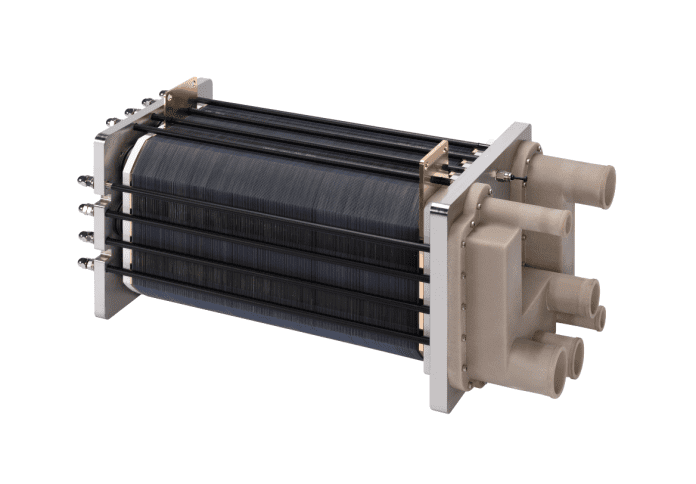
Australian manufacturer Siltrax has announced that its G-100 Proton Exchange Membrane fuel cell stack has secured TÜV certification, a manufacturing milestone the company says will accelerate commercial deployment in regulated global markets.
In a media release, Siltrax said the certification confirms the G-100’s compliance with IEC 62282-2-100, validating its safety architecture, manufacturing consistency and readiness for integration by original equipment manufacturers.
The certification was issued by TÜV and applies at the component level, which Siltrax said allows system integrators to rely on existing safety evidence rather than undertake duplicate testing.
Siltrax said the certification follows earlier independent testing by TÜV Rheinland that verified the performance of the silicon-based G-100 stack, including volumetric power density of up to 9.77 kW/L and gravimetric power density of up to 9.7 kW/kg.
According to the company, the results support its claims around size and weight efficiency for hydrogen fuel cell stacks.
Chief executive Dr Zhengrong Shi said the focus was on delivering certified hardware suitable for real-world manufacturing and commercial use.
“The TÜV certification is a critical business enabler,” Shi said. “We aren’t just building a more efficient fuel cell — we are providing a certified, safe and repeatable hardware platform that allows our partners to move toward commercial application with confidence.”
The company said its proprietary silicon-based bipolar plate architecture is intended to address durability and thermal management challenges in high-duty and weight-sensitive applications, including aviation and heavy transport.
Siltrax said the certified performance was achieved using mostly commercially available components, which it says leaves scope for further optimisation.
Siltrax said it is scaling manufacturing with an emphasis on repeatability, quality control and supply continuity, and is now offering G-100 evaluation units to selected OEMs and system integrators as it progresses toward broader commercial deployment.