Stanford University researchers are developing multimaterial 3D printing techniques aimed at expanding manufacturing applications across cultivated meat, robotics, energy storage, aerospace and other industries.
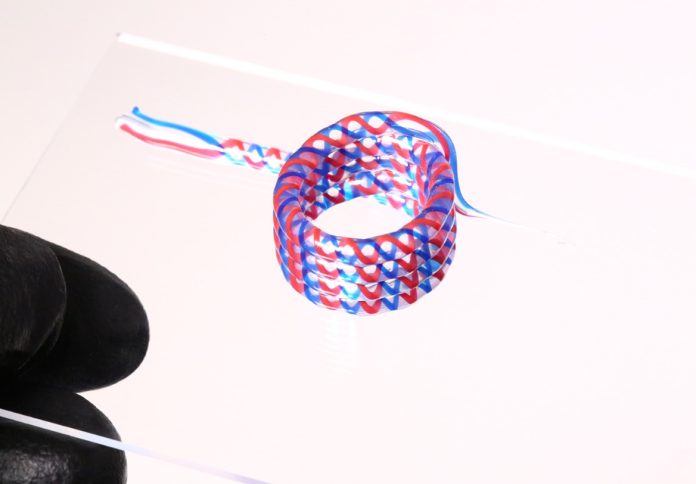
Assistant Professor Natalie Larson, who leads a 3D printing research lab at Stanford’s School of Engineering, is developing methods that can dispense multiple materials into complex geometries. The approach is designed to combine materials with different properties or functions within a single part.
“3D printing offers a whole new way of thinking about how we make things,” Larson said, adding that the technology has become increasingly accessible to individual creators and hobbyists.
Also known as additive manufacturing, 3D printing builds objects layer by layer or voxel by voxel from 3D model data, rather than removing material from a larger piece. According to Larson, researchers can now print plastics, ceramics, metals and composites, while multimaterial techniques are enabling combinations of different materials within a single component.
One area of research is cultivated meat, where Larson is working with Stanford researchers to develop a scalable 3D bioprinting process. The team is investigating sustainable, non-GMO ingredients and techniques for producing complex, thick, steak-like structures using muscle and fat bio-inks alongside sacrificial inks that can create channels for nutrient delivery during cell culture.
Larson said the work aims to address challenges including scalability, material sourcing and consumer appeal. The project is supported by the Stanford Sustainability Accelerator.
The lab is also applying multimaterial printing to soft robotics, with the aim of producing robots that can interact with delicate objects and systems. Such applications could include healthcare and handling tender produce such as berries.
“Multimaterial 3D printing, we aim to achieve similar performance by manufacturing multifunctional soft materials with embedded sensors and actuators in programmable complex geometries for target applications,” Larson said.
Larson said 3D printing has already become a standard production method in some areas requiring customised, low-volume components, including hearing aids, dental aligners and dentures. She noted, however, that the sustainability benefits of 3D printing depend on the application and production scale.
The technology can eliminate the need for moulds in some applications and allow parts to be produced when and where they are needed, potentially reducing inventory and shipping requirements. More complex geometries can also enable lighter components, which Larson said could support fuel efficiency in aerospace applications.
Her lab is additionally beginning research into 3D-printed structural battery composites with Stanford Associate Professor Adam Boies. Supported by the Precourt Institute for Energy and Sustainable Mobility Center, the project aims to combine energy storage and structural load-bearing functions in a single component.
Looking ahead, Larson said the lab is focused on developing printers with greater control over how multiple materials are placed, alongside imaging and computer-vision techniques to automate the printing process.
“Our overarching goal is to advance manufacturing processes to enable new classes of multifunctional materials,” Larson said.