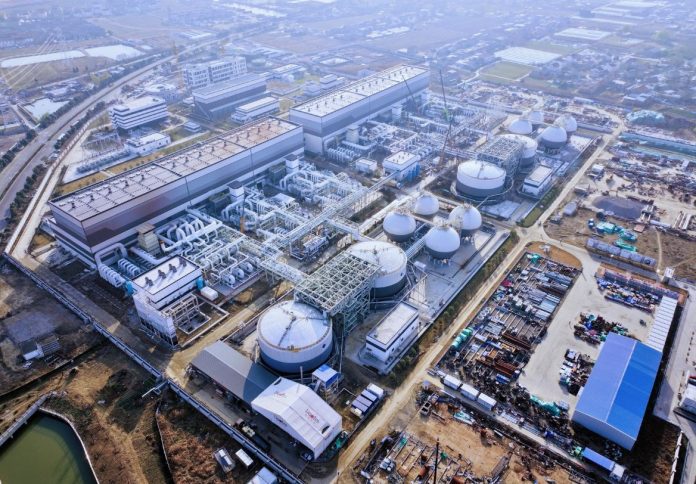
A groundbreaking energy storage project in China’s Jiangsu Province has become fully operational after completing its final commissioning phase, Shanghai Electric announced Wednesday.
The Huai’an Salt Cavern Compressed Air Energy Storage (CAES), now the largest of its kind globally, consists of two 300 MW units, providing a total capacity of 600 MW and storing up to 2,400 MWh of energy.
The facility’s second 300 MW unit recently connected to the grid and achieved full-load power generation at the first attempt, following the successful operation of the first unit, which began in December 2025.
In its announcement, Shanghai Electric said the project achieves about 71% conversion efficiency, making it effective at retaining the energy it stores. Compressed air is kept in salt caverns located 1.1 km to 1.5 km underground, utilising approximately 980,000 cubic metres of storage space.
The system uses a combination of molten salt and pressurised water to capture and reuse heat created during compression. This eliminates the need for fossil fuels in the process, making it a clear alternative to traditional storage systems.
Shanghai Electric provided the essential equipment for the project, including air turbine units, generators, electric motors and molten salt storage tanks. The company’s contributions covered both the power generation and thermal storage systems of the facility.
With a total investment of USD 520 million (AUD 739 million), the fully operational station is expected to generate 792 million kWh of electricity annually—enough to power approximately 600,000 households.
Shanghai Electricity said the facility is expected to reduce coal consumption by an estimated 250,000 tons and decrease carbon dioxide emissions by about 600,000 tons each year.
According to the company, long-duration energy storage technologies like CAES are becoming increasingly important for supporting renewable energy integration and improving grid stability. This comes at a time when the world is transitioning toward carbon neutrality.