Australian engineers have developed a 3D-printed titanium material that floats in water even after sustaining significant damage, in a development that could support future manufacturing of marine infrastructure, according to RMIT University.
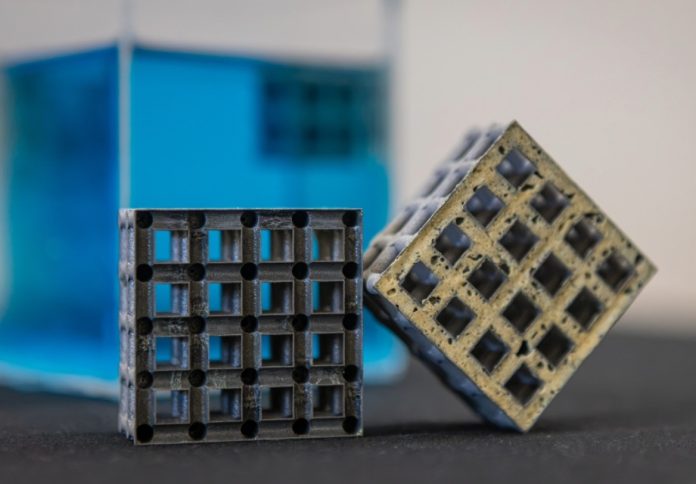
The research, led by RMIT’s Centre for Additive Manufacturing, produced a lightweight titanium lattice made of hollow, interconnected struts filled with polyurethane foam. RMIT said the material can remain buoyant while allowing water to flow through its external openings.
Lead researcher Dr Jordan Noronha said the development addressed a longstanding challenge for metallic lattice structures.
“Although metallic lattices can be incredibly light – with densities less than one-tenth the density of water – their open, interconnected spaces allow water to enter, causing them to sink,” Noronha said.
“This has made these strong, lightweight structures unsuitable for marine infrastructure – until now.”
According to RMIT, the researchers filled only the hollow titanium struts with foam, creating a hybrid structure designed to maintain buoyancy even after cracking and other damage.
The study, published in Advanced Materials, is described as the first reported demonstration of a floating metal-hybrid lattice metamaterial. Samples remained afloat in freshwater for more than two months, RMIT said.
The researchers also developed a measurement known as “skeletal density” to predict whether open structures will float. Unlike conventional density calculations, the measure considers only the parts of a structure that exclude water.
“This gives engineers a simple design rule: if the skeletal density is lower than that of the surrounding liquid, the structure will float – even when water flows through all its external openings,” Noronha said.
RMIT said testing showed the titanium structure was 70% stronger than stainless steel or high-density polyethylene at the same overall density. In short-term corrosion testing using natural seawater from Melbourne’s Port Phillip Bay, the structure lost 0.15% of its mass after two weeks, while its strength declined by less than 1%.
The hybrid lattice also remained buoyant after cracking, connection-point failures and the fracture of an entire lattice layer, according to the university.
“Tiny, sealed cells in the foam trap gas and prevent water from flooding the hollow struts,” Noronha said.
The team demonstrated the technology in a 3D-printed marine buoy that remained stable in a turbulent seawater tank tilted up to 45 degrees without a sealed casing, protective coating or additional flotation.
Project leader Distinguished Professor Ma Qian said the next stage would involve scaling up the components and testing their long-term performance under realistic marine and deep-sea conditions.
“By changing the material inside the titanium framework, we could tailor a similar structure for energy absorption, thermal management, vibration control and other applications,” Qian said.
RMIT led the research in collaboration with the Conservatoire National des Arts et Métiers in France, with support from the Australian Research Council and RMIT’s School of Engineering.