An Australian-developed floating desalination system has been named the country’s only contender in a major international competition focused on addressing global water scarcity, according to a media release from Blue Carbon.
The company’s oPod™ Aqua, a pendulum-shaped desalination pod operating off Tasmania’s north coast, was selected as one of 20 semi-finalists in Track A of the XPRIZE Water Scarcity competition.
The competition received entries from 674 teams across 86 countries in 2024 and forms part of a five-year, $119 million initiative aimed at improving access to clean water through seawater desalination technologies.
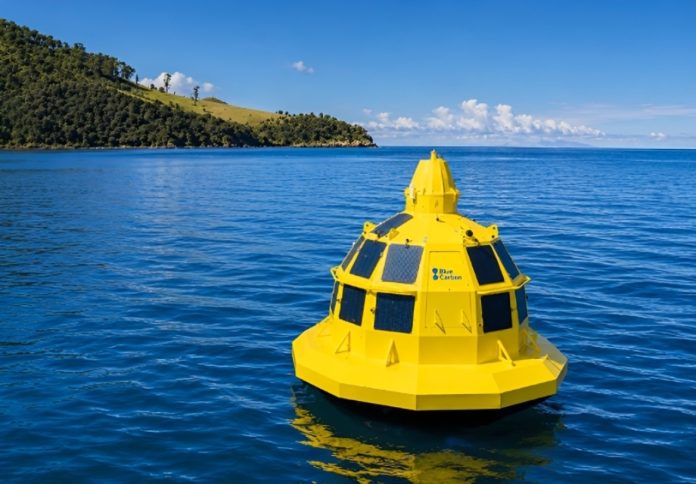
Tethered in Okehampton Bay near Orford, the 26-metre-long unit uses wave, solar and wind energy to convert seawater into drinking water. Most of the structure remains below the surface, with only a five-metre buoy-like section visible above water.
According to Blue Carbon, the oPod™ Aqua operates entirely off-grid, drawing water from below the ocean surface using wave action before desalinating it with support from onboard solar panels and wind turbines. The prototype is capable of producing 100 litres of fresh water per hour and can store more than 6,000 litres in onboard tanks.
The company said the system is designed to reduce some of the environmental and infrastructure challenges associated with conventional land-based desalination plants. It stated that leftover brine from the process is only slightly saltier than surrounding seawater and is rapidly diluted in open water through the pod’s upwelling flows.
Blue Carbon also said larger-scale versions are in development, with future units expected to produce between 20,000 and 50,000 litres of water per day by replacing electric pumps with wave-driven flow systems.
“At the heart of the system is Blue Carbon’s passive fluidic logic — a mechanical computer that removes the need for complex sensors and controls,” Blue Carbon chief executive Dr Ana Novak said in the release.
“With fewer moving parts, it’s more durable, easier to maintain and lowers the cost of water,” Dr Novak said.
The oPod™ Aqua forms part of a broader suite of ocean-based technologies being developed by Blue Carbon, which was co-founded by Dr Novak and Eva Chiu.
Blue Carbon acknowledged support from deployment partners including BLW Marine Management, Marine Solutions, Rock Electrical & Solar and West Marine.
The XPRIZE Water Scarcity competition was launched in March 2024 with support from the Mohamed bin Zayed Water Initiative, a non-profit organisation focused on addressing global water scarcity challenges.
An Australian-developed floating desalination system has been named the country’s only contender in a major international competition focused on addressing global water scarcity, according to a media release from Blue Carbon.
The company’s oPod™ Aqua, a pendulum-shaped desalination pod operating off Tasmania’s north coast, was selected as one of 20 semi-finalists in Track A of the XPRIZE Water Scarcity competition. The competition received entries from 674 teams across 86 countries in 2024 and forms part of a five-year, $119 million initiative aimed at improving access to clean water through seawater desalination technologies.
Tethered in Okehampton Bay near Orford, the 26-metre-long unit uses wave, solar and wind energy to convert seawater into drinking water. Most of the structure remains below the surface, with only a five-metre buoy-like section visible above water.
According to Blue Carbon, the oPod™ Aqua operates entirely off-grid, drawing water from below the ocean surface using wave action before desalinating it with support from onboard solar panels and wind turbines. The prototype is capable of producing 100 litres of fresh water per hour and can store more than 6,000 litres in onboard tanks.
The company said the system is designed to reduce some of the environmental and infrastructure challenges associated with conventional land-based desalination plants. It stated that leftover brine from the process is only slightly saltier than surrounding seawater and is rapidly diluted in open water through the pod’s upwelling flows.
Blue Carbon also said larger-scale versions are in development, with future units expected to produce between 20,000 and 50,000 litres of water per day by replacing electric pumps with wave-driven flow systems.
“At the heart of the system is Blue Carbon’s passive fluidic logic — a mechanical computer that removes the need for complex sensors and controls,” Blue Carbon chief executive Dr Ana Novak said in the release.
“With fewer moving parts, it’s more durable, easier to maintain and lowers the cost of water,” Dr Novak said.
The oPod™ Aqua forms part of a broader suite of ocean-based technologies being developed by Blue Carbon, which was co-founded by Dr Novak and Eva Chiu.
Blue Carbon acknowledged support from deployment partners including BLW Marine Management, Marine Solutions, Rock Electrical & Solar and West Marine.
The XPRIZE Water Scarcity competition was launched in March 2024 with support from the Mohamed bin Zayed Water Initiative, a non-profit organisation focused on addressing global water scarcity challenges.