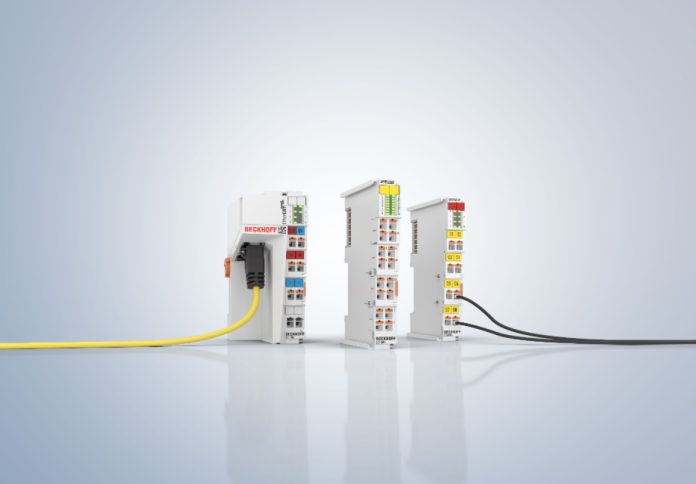
Beckhoff has launched its new EtherCAT ED Series, describing the platform as an evolution of its existing EtherCAT terminal range designed to improve installation, serviceability and maintenance while maintaining compatibility with existing infrastructure used across manufacturing and industrial automation environments.
The company said the release builds on the development of EtherCAT, the industrial Ethernet technology originally created by Beckhoff and opened to the wider market in 2005.
According to Beckhoff, EtherCAT is now used in 78 countries, supported by more than 8,000 member companies and has surpassed 100 million deployed nodes worldwide.
Supriya Suhale, Category Manager at Beckhoff Automation Australia, said the ED Series was developed to modernise the company’s I/O portfolio without requiring customers to replace existing systems.
“Beckhoff is taking the next step with the launch of its new ED Series – an evolution of its widely adopted EtherCAT terminal platform that modernises usability, serviceability and installation, while protecting the investments customers have already made in existing infrastructure,” Suhale said.
She said the company’s objective was to update and future-proof the platform while maintaining cost competitiveness.
“The intention was to modernise the portfolio with a new look, improved mechanics and a technological update, while remaining price competitive,” she said.
According to Beckhoff, the ED Series retains the same form factor and architecture compatibility as the existing EL Series, allowing users to deploy new modules alongside established terminals on the same EtherCAT network.
“Creating an entirely new system would have disrupted thousands of installations globally and forced customers into costly infrastructure overhauls,” Suhale said. “Instead, the ED Series maintains the same form factor and architecture compatibility as the existing EL Series.”
The company said the platform is compatible with TwinCAT 3 and existing EtherCAT environments, although updated functionality requires new ESI files and may necessitate software updates during integration.
Among the changes introduced in the ED Series are tool-free push-in wiring connections, app-based diagnostics, DMC code traceability and standardised form factors and LED layouts intended to simplify installation, troubleshooting and maintenance.
“We have now included a tool-free push-in wiring connection to speed up the installation process,” Suhale said.
Beckhoff said the diagnostic application operates in a read-only mode, enabling technicians to access terminal status information on mobile devices without affecting system operation.
The company also said the new platform is designed to reduce downtime and lower total cost of ownership through faster commissioning, simplified maintenance and streamlined fault identification.
“Faster commissioning, simplified maintenance, easier replacements and app-based fault finding all contribute to reduced downtime and improved system availability,” Suhale said.
Beckhoff identified automotive, packaging, food and beverage, process industries and general manufacturing as sectors likely to benefit from the technology.
“We are proud to produce a solution that enhances production in high-volume manufacturing environments,” Suhale said. “Even small reductions in commissioning time or maintenance complexity can translate into substantial operational savings.”
The launch forms part of Beckhoff’s broader strategy around modular and scalable automation systems. Suhale said the ED Series integrates with the company’s wider automation portfolio, including TwinCAT software, machine vision, drive technology, AI integration and PC-based control systems.
“With the ED Series, Beckhoff is not asking customers to start over,” she said. “We always evolve our hardware to reduce integration complexities and without forcing platform changes.”
This article contains product information provided by Beckhoff and is intended for general information only. Please seek professional advice and/or contact Beckhoff directly before making decisions based on this information.