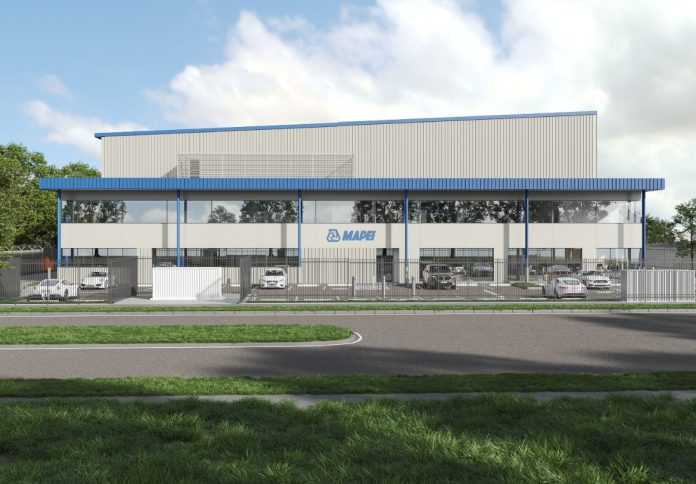
Global building materials manufacturer Mapei has commenced construction on a new $60 million manufacturing facility in Truganina, Melbourne, in a move the company says will significantly expand its Australian production capacity and strengthen its role in supporting major infrastructure projects.
Speaking exclusively to Australian Manufacturing, Mapei Australia General Manager Marco De Santis said the investment represents a key milestone in the company’s long-term manufacturing strategy in the country, particularly as demand for construction materials continues to grow alongside Victoria’s expanding infrastructure pipeline.
“This new facility in Truganina represents a major step in strengthening our long-term manufacturing strategy by enabling faster delivery, lower transport emissions, and improved support for the evolving needs of our customers and partners in delivering critical infrastructure projects across Victoria,” De Santis said.
He added that the company’s existing Wacol, Brisbane plant currently produces 67,000 tonnes of powder products and 12 million litres of liquid annually, with the new Melbourne facility expected to significantly expand overall capacity to meet rising market demand.
Expanding local manufacturing capability
From a manufacturing perspective, De Santis said the primary change introduced by the Truganina facility would be scale, rather than an immediate shift in product categories.
“Strengthening our supply chain is a key objective. We will increase the number of locally produced products, but the categories of production will remain the same initially,” he said.
A key operational difference will be the introduction of more advanced packaging systems, including machinery designed to package mortar products in recyclable plastic packaging.
According to De Santis, the shift away from paper-plastic composite materials is intended to improve recyclability outcomes in Australia as domestic recycling infrastructure continues to evolve, while also improving product protection in site conditions such as moisture and handling.
Strengthening supply chains amid industry pressures
The investment comes at a time when Australia’s construction sector continues to face supply chain disruptions, materials shortages and ongoing labour constraints, alongside a national infrastructure pipeline valued at more than $213 billion.
In Victoria alone, the 2025/26 State Budget includes $8.1 billion in new capital investment, reinforcing the state’s ongoing infrastructure program.
De Santis said the Truganina facility is expected to play a role in improving supply chain resilience by increasing localisation of manufacturing and expanding onshore production of key materials.
“In Victoria, material availability remains a critical risk for regional projects and complex builds,” he said.
“With this approach, we aim to strengthen supply chain resilience and support the local production of nearly 100 products, helping to mitigate delivery risks and ensure more reliable project execution.”
Strategic location for distribution efficiency
The Truganina site has been positioned near major transport infrastructure, approximately 18 kilometres from Melbourne’s CBD and airport, with direct access to key freight corridors including the M1, M80 and M8 highways.
De Santis said this connectivity is expected to support more efficient distribution across Victoria and interstate markets, particularly for large-scale infrastructure projects requiring high-volume material supply.
“Mega projects like the Suburban Rail Loop and North East Link require large volumes of product, often supplied in bulk,” he said.
“Efficient logistics ultimately help us improve service levels, reduce delivery times, and optimise transportation efficiency.”
Automation, quality control and sustainability focus
De Santis said the Truganina facility has been designed with a focus on automation, quality consistency and sustainability, incorporating advanced systems across both powder and liquid production lines.
He said the powder plant includes automated dosing, packaging and palletising systems, with micro-dosing technology designed to improve precision in raw material handling and maintain consistent product quality.
The liquid plant will operate with a fully automated mixing system connected to a tank farm, supporting raw material supply management and finished goods storage.
“Quality control is embedded throughout the operation through automated processes that minimise variability and ensure consistency batch after batch,” he said.
Sustainability features include solar energy integration, recyclable packaging systems, dust emission reduction measures, and reduced reliance on plastic intermediate bulk containers through expanded silo storage.
Workforce development and skills approach
Addressing ongoing labour and skills shortages in Australian manufacturing, De Santis said Mapei is focusing on structured onboarding, training and internal capability development to support workforce growth.
“Every new starter undertakes a comprehensive induction program that provides clear role expectations and equips them with the knowledge and skills needed to perform their duties safely and efficiently,” he said.
He added that ongoing workforce development includes regular performance assessments and targeted training initiatives, both internal and external.
Approximately one-third of Mapei’s workforce has more than five years’ tenure, which the company attributes to its workplace culture and employee development systems.
Confidence in Australia’s manufacturing outlook
On a global level, De Santis said the Truganina investment forms part of Mapei’s broader international expansion strategy, which includes manufacturing investments across Europe, the UK, Egypt, Denmark and Chile.
He said the Australian facility reflects confidence in the long-term growth of the local construction sector and its role within the company’s global production network.
“This commitment sits within Mapei’s broader global investment strategy,” he said.
“Our approach has always been to build local operations that can support our customers within each region while positioning the country as an important part of Mapei’s global network of production hubs.”
Long-term role in Australian manufacturing
Looking ahead, De Santis said Mapei expects to play an increasing role in supporting Australia’s domestic manufacturing capability in construction materials through investment in production, technical expertise and supply chain resilience.
“As the industry evolves, there will be an increasing demand for advanced construction solutions, sustainable materials, and reliable local supply partners,” he said.
“We see Mapei contributing not only through manufacturing capacity, but also through technical support, product development, workforce capability, and collaboration with the broader construction industry.”
This article contains information provided by Mapei and is intended for general use only. It does not take into account your personal, professional, or business circumstances.