Australian-headquartered explosives company Dyno Nobel has unveiled a prototype autonomous system designed to automate drill and blast processes at mining sites, potentially reducing the need for workers to enter high-risk blast zones.
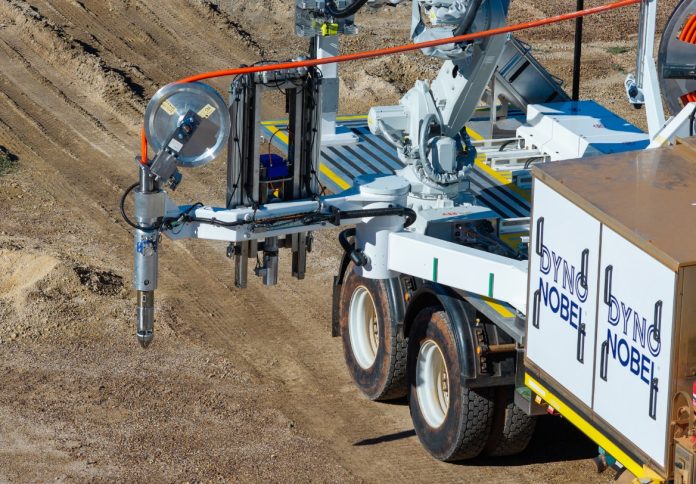
The company said the technology, developed through five years of research and development, can autonomously coordinate blast hole inspection and loading, including the deployment of initiating systems and bulk explosives.
Dyno Nobel Chief Technology Officer Dirk Van Soelen said the system was designed to address parts of the drill and blast process that remain manually operated.
“Dyno Nobel is very proud to announce that we have successfully built a fully operational, end-to-end process, which can autonomously deploy initiating systems and bulk explosives on a bench, at scale,” Van Soelen said.
According to Dyno Nobel, the technology can autonomously measure, prime, load, stem and record each blast hole. The system uses sensors across its components to capture data and is designed to integrate with existing mine systems and other autonomous technologies.
“Every component of Dyno Nobel’s Autonomous Bench is equipped with sensors, allowing unprecedented data capture and analysis providing not only valuable management information but also repeatability and predictability of the drill and blast process,” Van Soelen said.
The company said the system is intended to allow these processes to be coordinated from a control centre away from the blast zone. Dyno Nobel said this could support mining in areas where safety risks or unstable conditions have previously made extraction difficult.
The fully built prototype is set to be trialled by software-first minerals project developer and operator Mariana Minerals at Copper One, an autonomy-focused mine and copper refinery in Utah, USA.
Mariana Minerals Co-Founder and CTO Juan Lozano said the company would contribute to the technology’s development through trials in an operating mine environment.
“We’re excited to work with Dyno Nobel to trial this technology at Copper One and to contribute to its development in an operating mine environment,” Lozano said.
Lozano said the trial would also support Copper One’s broader approach to integrating autonomous systems across mining and processing operations.
“Our goal at Copper One is end-to-end mining & processing autonomy, and blasting sits right at the start of that chain,” he said.
Dyno Nobel said it plans to roll out the technology through a staged pathway to mid-2027, beginning with trials in the USA before expanding to further countries.
Van Soelen said the system was intended to make the drill and blast process more consistent while increasing data collection across operations.
“I am incredibly proud that our technology is opening up a world where each blast can be safer and more precise, with less variability than the one before,” he said.