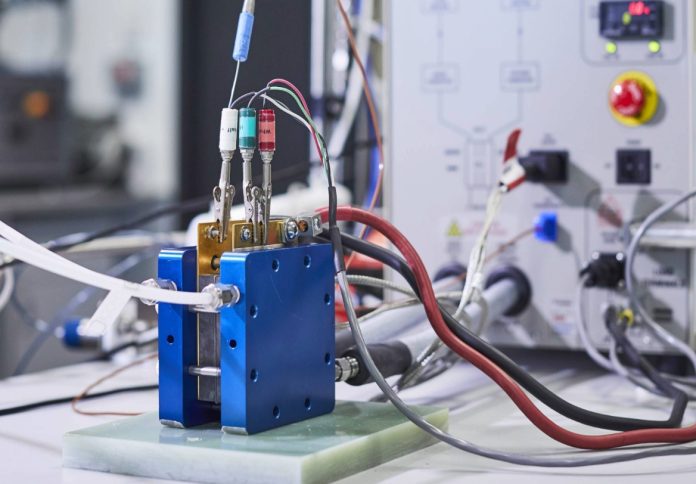
Researchers from UNSW Sydney have unveiled a redesigned hydrogen fuel cell that they say addresses a longstanding technical limitation, potentially advancing the use of clean energy in sectors such as freight, transport and aviation.
Hydrogen fuel cells, particularly those powered by locally produced green hydrogen, have long been considered a promising low-emissions energy source. However, challenges in efficiency and performance have hindered their widespread commercial adoption.
According to the UNSW-led research team, the issue lies in water management within the cell. While hydrogen fuel cells produce electricity with water as their only byproduct, some of this water can become trapped, obstructing oxygen flow and reducing performance. Existing solutions to this problem have typically involved complex systems that increase both cost and weight.
The study, led by Quentin Meyer and Chuan Zhao from the School of Chemistry, proposes a structural redesign aimed at mitigating this issue. The findings have been published in the journal Applied Catalysis B: Environment and Energy.
“Hydrogen fuel cells generate clean electricity with water as the only byproduct,” said Dr Meyer, a senior research fellow and first author of the study. He added that while the technology has the potential to deliver “cheap, abundant clean energy,” translating this into practical emissions reductions has been difficult.
The team’s approach introduces microscopic channels within the fuel cell architecture, allowing excess water and gas to escape before they accumulate. These “lateral bypasses,” as described by the researchers, are designed to improve efficiency without significantly increasing manufacturing complexity.
“There’s usually no way to remove water,” Dr Meyer said. “But these ‘lateral bypasses’ act as escape routes, meaning water no longer accumulates and stops the cell working.”
The researchers report that the redesigned fuel cell can achieve up to 75 per cent more power compared to conventional designs.
Contributors to the project include Peyman Mostaghimi from the School of Civil and Environmental Engineering and Ying Da Wang from the School of Minerals and Energy Resources Engineering, who highlighted the combination of imaging, simulation and micro-engineering techniques used in the work.
“We’re rethinking hydrogen fuel cells in Australia by combining advanced imaging, fluid flow simulations, and precision micro-engineering,” they said in a joint statement.
Professor Zhao said the development could expand the viability of hydrogen technologies across multiple applications. “This breakthrough could be used in a range of different settings and brings cheap, clean, and abundant hydrogen energy to within our reach,” he said.
The team also noted that the design may reduce reliance on expensive materials such as platinum, while contributing to lighter and potentially lower-cost systems overall.
In terms of application, the researchers pointed to aviation and freight as areas where hydrogen fuel cells could play a role, particularly where battery technologies face limitations.
“I believe aeroplanes will be powered by hydrogen fuel cells in the very near future,” Dr Meyer said, while Professor Zhao added that redesigning the cells makes “lightweight aviation a lot more realistic.”
The researchers indicated that initial deployment efforts may focus on low-altitude aircraft, where hydrogen systems could already offer longer operating times than battery-powered alternatives.
The lateral bypass technology has been patented by Dr Meyer and Professor Zhao, and the team is currently working to scale the design for broader use.