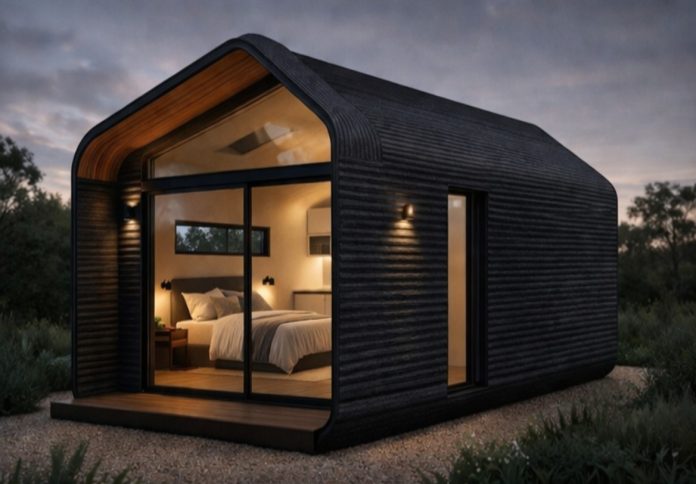
Manufacturing innovation is at the centre of a new housing project, with Hyperion Systems, an Australian advanced manufacturing company, confirming a contract for a modular tiny home built from recycled plastic.
According to Hyperion Systems, the contract with Little Castles Small Homes will see the core structure of the tiny home produced using recycled polymer feedstock and advanced additive manufacturing techniques, with printing expected to take around 48 hours.
Hyperion Systems chief executive Josh Wigley said the agreement marks a step forward for both sustainable construction and local manufacturing capability.
“We will be using recycled polymers as our base feedstock and through the intellectual property we have developed in-house we will be able to print the core structure for a tiny home in around 48 hours,” he said.
Under the arrangement, core components will be manufactured in modular sections at the company’s Henderson facility before being transported for final fit-out and completion by Little Castles Small Homes.
Wigley said the use of recycled polymers could provide additional functional benefits.
“Being constructed out of recycled polymers the structure will be termite resistant and have beneficial thermodynamic properties,” he said.
He added that the project is intended to meet all relevant Australian building code requirements, with a focus on safety, durability and compliance alongside sustainability goals.
“This build will mark the first 3D printed polymer house in the Southern Hemisphere, positioning Western Australia at the forefront of innovative, sustainable housing solutions,” Wigley said.
He said the approach could also contribute to broader housing supply challenges by improving efficiency.
“By accelerating build times and freeing up skilled labour to focus on more traditional home builds, the technology offers a pathway to delivering more housing at scale,” he said.
Little Castles Small Homes representative Mark Hughes said the company viewed the project as an opportunity to explore alternative construction methods.
“We’re not just building a tiny home differently—we’re shaping how homes should be built into the future,” he said.
“More sustainable, more considered, and making better use of what we already have. It’s about creating healthier spaces and proving that smaller homes can still deliver a higher standard of living.”
Hyperion Systems said the project aligns with circular economy principles by reusing plastic materials, while demonstrating how advanced manufacturing processes could be applied in residential construction.