A nanomanufacturing-driven imaging chip developed through collaboration between Zhejiang University and RMIT University could allow cameras and sensing systems to detect far more detail than conventional colour imaging, including subtle differences in materials and environments that are otherwise indistinguishable to the human eye, according to researchers.
The study, published in Nature Electronics, demonstrates an approach in which light analysis is integrated directly into imaging hardware rather than relying on separate laboratory instruments.
The researchers say the nanomanufacturing-based design could support applications in machine vision, automated inspection and environmental monitoring by enabling spectral information to be captured at the point of imaging.
“Cameras are highly effective at capturing images, but applications such as machine vision, automated inspection and environmental monitoring depend on understanding different colours and wavelengths of light, not just what something looks like,” the researchers noted in describing the motivation behind the work.
They added that such information can reveal differences in materials or surface conditions that appear identical in standard imaging.
RMIT researchers, including Distinguished Professor Baohua Jia from RMIT’s Centre for Atomaterials and Nanomanufacturing, contributed expertise in nanomanufacturing, optical characterisation and device testing, working alongside the Zhejiang University team led by Professor Jianrong Qiu. The collaboration also included Dr Han Lin from RMIT as a co-author.
Jia said the approach moves beyond traditional post-processing techniques. “This is not about adding more image processing after the fact,” she said. “It introduces a new physical component that separates light at a very small scale, close to the sensor itself.”
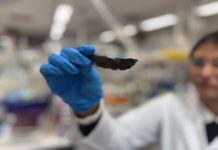
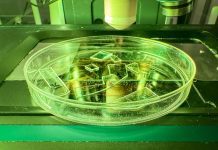
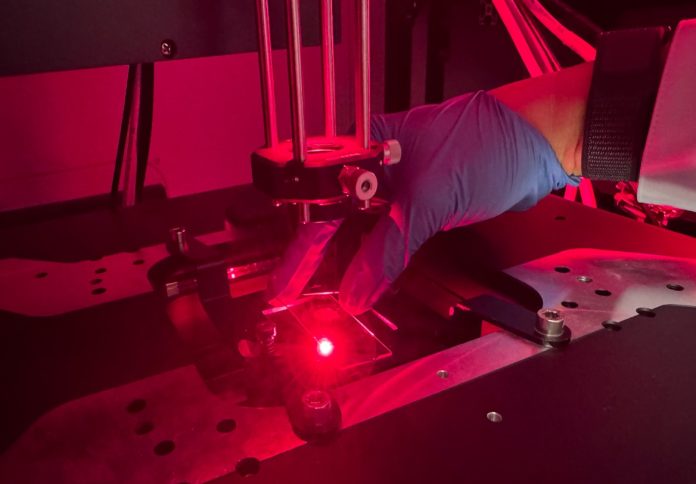
The device was fabricated using ultrafast laser pulses to create spiral-shaped microstructures inside transparent materials. These act as microscopic light sorters, breaking incoming light into patterns that can be read by a sensor, enabling compact spectral analysis without external equipment.
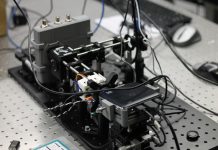
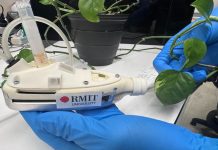
The researchers demonstrated a prototype by integrating the structure with a commercial image sensor, showing it could capture spectral information and support microscopic spectral imaging across visible and near-infrared wavelengths.
Lin said the results mark an important step in translating the concept into usable technology, noting that it helps “move the discussion from what is theoretically possible to what kinds of sensing systems could realistically be built in the future.”
Qiu said the work remains at an early stage but demonstrates a viable pathway for compact sensing systems. “Demonstrating that a concept works at the chip level is a critical step,” he said.
The researchers said future work will focus on scaling fabrication methods, testing additional materials and refining reconstruction software to improve how light information is interpreted from the chip.