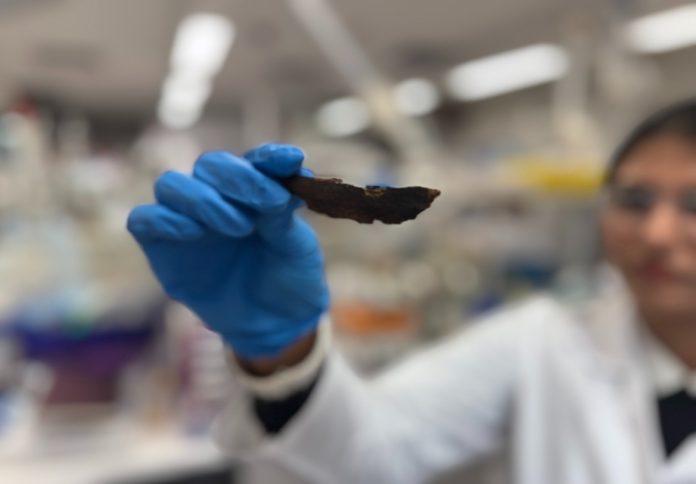
Eucalyptus bark, typically stripped from logs and discarded as forestry waste, could be repurposed into materials for cleaning polluted water, filtering air and capturing carbon dioxide, according to new research from RMIT University.
The study shows the bark can be converted into a highly porous form of carbon capable of trapping pollutants as water or air passes through it, offering a potential pathway to transform an abundant by-product of forestry operations into a useful environmental material using a relatively simple process.
Researchers noted that porous carbon materials are already widely used in water filtration, air purification and industrial gas treatment because of their internal structure. Their effectiveness comes not from the raw material itself, but from a network of microscopic pores that capture unwanted molecules as fluids move through.
RMIT University PhD researcher Pallavi Saini, who led much of the experimental work, said eucalyptus bark performed strongly despite being considered low-value waste.
“It is usually treated as low-value waste, but with a simple process we were able to convert it into a highly porous material with strong adsorption performance,” Saini said.
“It highlights how overlooked biomass can be transformed into something useful.”
In the study, RMIT University researchers used a one-step activation process to produce porous carbon from eucalyptus bark. While similar methods have been explored using other biomass sources, many existing porous carbon materials are still produced through more complex, multi-stage processes requiring higher energy input and infrastructure.
RMIT University researcher Dr Deshetti Jampaiah said the simplicity of the approach is a key advantage.
“The strength of this approach lies in its simplicity,” Jampaiah said. “We are converting a widely available waste material into a functional carbon with promising performance, without relying on complex processing steps. That makes it highly relevant for real-world environmental applications.”
Australia is home to more than 900 species of eucalypt and related trees. As a next step, the RMIT University team plans to collaborate with Indigenous knowledge holders and organisations with deep ecological expertise to help identify which species may be best suited for future applications.
The researchers also aim to further optimise the material by examining species-specific chemical and structural properties, combining scientific analysis with long-standing ecological knowledge.
Because eucalyptus bark is a by-product of existing forestry operations, the approach does not compete with food production and aligns with circular economy and waste-reduction goals being explored by RMIT University researchers.
Distinguished Professor Suresh Bhargava AM of RMIT University said the work highlights how waste materials can be reimagined as environmental solutions.
“This work shows how eucalyptus bark can be transformed into materials that support cleaner water, cleaner air and carbon capture,” Bhargava said. “At CAMIC, we combine circular-economy innovation with real societal impact, while mentoring the next generation of researchers to ensure the work remains purposeful.”
The research, titled Sustainable valorisation of eucalyptus bark waste into microporous carbon materials for efficient CO? capture, was published in the international journal Biomass and Bioenergy (DOI: 10.1016/j.biombioe.2026.109242).