A new manufacturing-oriented control system developed at the Oak Ridge National Laboratory is improving the reliability of large-scale 3D printing by detecting and correcting errors in real time.
According to ORNL researchers, the tool is designed to support manufacturers producing large composite parts by reducing defects, material waste, and production costs in additive manufacturing processes.
Researchers said the system could strengthen domestic manufacturing competitiveness by improving how large plastic composite parts are produced, including components used in transportation, construction, and other industrial sectors.
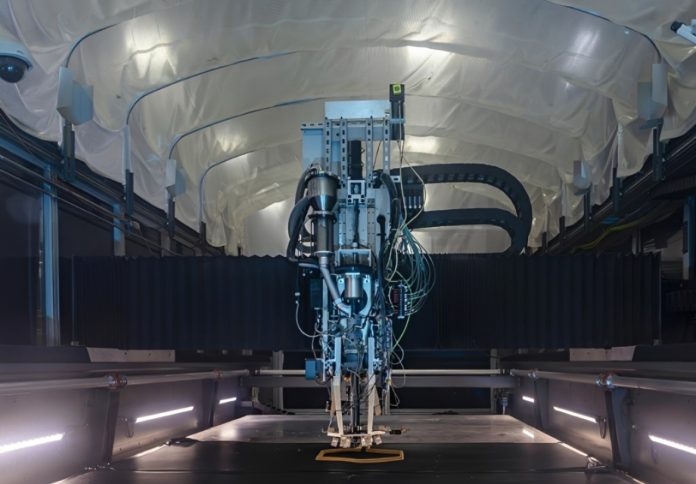
Large-area additive manufacturing involves depositing heated plastic through a robotic nozzle layer by layer to form structures such as building walls, vehicle components, or aircraft parts.
According to ORNL, the process requires tight control of variables such as temperature, nozzle speed, and cooling rates to ensure layers properly fuse without deforming.
“It is novel that our controller can sense what is happening and react in real time,” said Kris Villez, the project’s lead researcher at ORNL. “It controls the process almost like a human would: by observing and nudging the setting until it reaches the desired outcome.”
The ORNL system integrates traditional sensors with low-cost thermal cameras mounted around the printing nozzle. Computer vision, a form of artificial intelligence used to interpret images, allows the system to analyze live thermal data and detect temperature deviations as material is deposited.
When inconsistencies are identified, the controller automatically adjusts printing speed to help ensure each layer cools to the correct temperature before the next is applied. ORNL said this helps reduce failed prints and improves layer bonding.
Chris O’Brien, a graduate student at the University of Tennessee, Knoxville who worked with ORNL researchers, said the system can detect and correct temperature differences of just a few degrees, which is critical because small variations can lead to part failure.
In testing, researchers produced a large hexagon-shaped part larger than a truck tire. When initial printing conditions resulted in material cooling about 30% below target before subsequent layers were added, the system adjusted print speed automatically to restore appropriate temperature conditions, demonstrating real-time correction capability.
Unlike some monitoring approaches, ORNL researchers said the controller does not require retraining for each new design, potentially reducing computing demands and improving flexibility across different printers, materials, and part geometries.
Villez said the system was designed to be broadly adaptable. “It is designed to work with any large-area composite printer, any type of plastic, and any shape,” he said.
The work builds on earlier ORNL research conducted with Purdue University and the University of Maine, which explored combining thermal imaging with statistical modeling for defect detection in large-scale additive manufacturing.
Villez said the next step is greater automation in manufacturing environments. “There is a vast opportunity space to make these machines more intelligent and more responsive,” he said. “In the end, we’d love this to work like baking bread: You set the oven temperature, put in your dough, and return when the timer goes off to see if it’s done.”
The project also involved ORNL researchers Katie Copenhaver and Alex Roschli and was supported by the U.S. Department of Energy Office of Science and its Advanced Materials and Manufacturing Technologies Office. UT-Battelle manages ORNL for the DOE Office of Science, which funds basic research across the physical sciences.