
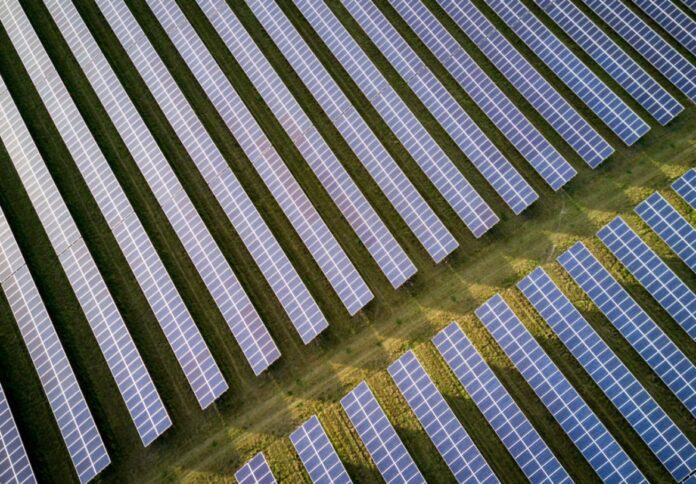
Manufacturing the next generation of solar technology will require testing beyond the laboratory, with UNSW Sydney researchers exposing commercial-sized perovskite and tandem solar modules to Australia’s challenging outdoor conditions.
The five-year, $18 million project will field-test up to 160 modules at UNSW’s Water Research Laboratory in Manly Vale, where they will be exposed to changing temperatures, humidity, ultraviolet light, rain, salty air and storms. The project is supported by $5.6 million from the Australian Renewable Energy Agency (ARENA).
UNSW Sydney Dr Jessica Yajie Jiang, who is leading the project, said outdoor testing was necessary to understand how the emerging technologies perform under real conditions.
“You have to test them in the outdoor environment and see how they really perform,” Dr Jiang said. “Each module has its own personality. You need to dive in and understand the failure mechanism for each one.”
The research focuses on perovskite and perovskite-silicon tandem technologies, which are being developed as alternatives to conventional silicon solar panels.
According to UNSW, silicon has driven the growth of photovoltaic technology but is approaching its theoretical efficiency limit. Perovskite materials can absorb different parts of the solar spectrum, allowing the two materials to be combined in tandem cells to potentially increase efficiency.
“The perovskite absorbs one part of the sunlight and the silicon absorbs another,” Dr Jiang said. “Together, they maximise the use of the entire solar spectrum.”
However, UNSW said the durability of perovskite technology remains an area requiring further investigation. Unlike silicon, perovskite materials can degrade under sunlight, humidity and other environmental conditions.
“The question is whether these perovskite modules will give us the lifetime we expect,” Dr Jiang said.
The project will test both single-junction perovskite modules and different tandem configurations, including modules that integrate perovskite directly onto silicon and those that stack separate devices.
Researchers will continuously monitor module performance, using 80 per cent of a module’s initial output as a key degradation benchmark. The results will then be compared with controlled indoor testing and microscopic and nanoscale analysis to identify the causes of degradation.
“We are not just trying to see that a module has failed,” Dr Jiang said. “We want to understand why – what is really going on and identify the degradation mechanism at the nanoscale.”
The findings will be shared with manufacturers to support changes to materials, designs or manufacturing processes before updated modules are returned for further testing.
The project brings together UNSW, Trina Solar, MicroQuanta, the University of Surrey and CSIRO, along with other manufacturers whose involvement remains confidential. UNSW said confidentiality agreements will be used to protect commercially sensitive information, with comparative results able to be anonymised where required.
“We want to provide confident, independent evidence of how these modules perform outdoors,” Dr Jiang said. “Then, investors, governments and industry can have a much better understanding of whether the technology is ready.”
The field-testing project began this year and is scheduled to run until 2031.