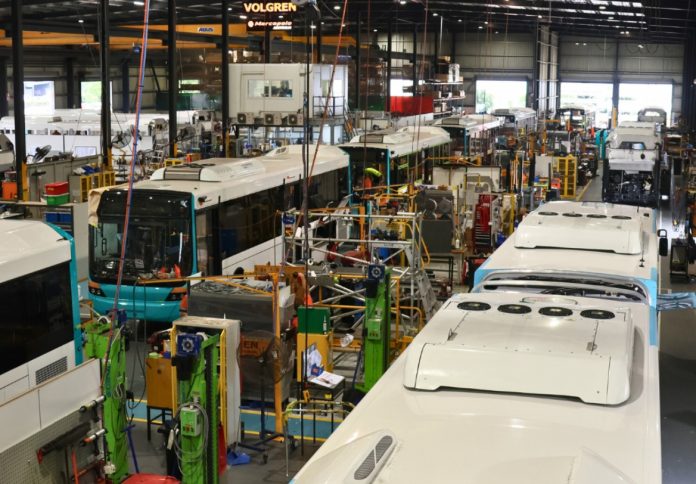
Volgren’s Eagle Farm facility has expanded its manufacturing capability over the past 17 years, with the Queensland site now producing a range of conventional and zero-emission buses for transport programs across the state and Australia.
Established in 2009 following a contract with Brisbane City Council, the facility has since completed more than 2,000 locally built buses, including nearly 1,000 delivered to Brisbane City Council.
In a news release, Volgren said production at the site had increased in recent years, with about 520 buses manufactured between 2021 and 2025. Of these, 407 were delivered to the Queensland market, including almost 200 for the Department of Transport and Main Roads during 2024 and 2025.
Annual output has increased from about 60 buses in earlier years to more than 180 in 2024, with the facility now capable of manufacturing more than 250 vehicles a year.
Volgren CEO Thiago Deiro said the growth reflected investment in local manufacturing skills and customer relationships.
“The development of our Queensland facility demonstrates what can be achieved through continued investment in Australian manufacturing and local skills,” Deiro said.
“Today, our team can support major fleet programs and manufacture a broad range of vehicles, from conventional route buses through to articulated and zero-emission transport solutions.”
The company said its Queensland workforce had grown from approximately 60 employees in 2019 to around 160 in 2026, with capabilities spanning manufacturing, engineering, quality assurance, logistics, project delivery and aftersales support.
The Eagle Farm site has also expanded its production capabilities to include articulated buses and electric vehicles. More than 60 articulated buses have been manufactured at the facility, while projects are underway to produce its first electric articulated buses at the site.
For the Brisbane Metro project, the Queensland team completed final assembly of 58 bi-articulated electric vehicles developed in partnership with Swiss manufacturer HESS.
Volgren said the facility was also supporting the adoption of zero-emission transport in Queensland, with close to 50 of its battery-electric buses operating across the state with the Department of Transport and Main Roads, Kinetic, Keolis Downer and Transdev.
The company has also completed two hydrogen fuel-cell electric buses with Wrightbus, adapted for Australian operating conditions.
Deiro said the facility’s capabilities were supported by its workforce and supply chain.
“This capability is underpinned by the expertise of our people and the strong partnerships we have developed with customers, technology partners and local suppliers,” he said.
Volgren said it worked with more than 690 Australian suppliers to increase manufacturing capacity, qualify additional partners and strengthen inbound logistics.
The company said the continued development of Eagle Farm was intended to support its broader manufacturing network while providing buses designed and supported for Australian operating conditions.