Australian manufacturing automation company Beckhoff Automation says its long-running partnership with machine builder Modra Technology has supported the development of CreelMT, an automated creel management system designed to improve efficiency in carpet manufacturing.
The system combines motion control, robotics, distributed I/O, safety systems and software through a single Beckhoff automation platform.
According to Beckhoff, CreelMT is designed to reduce production downtime and manual handling while providing flexibility across different factory layouts, production capacities and customer requirements.
Yousuf Saleem, National Sales Manager at Beckhoff Automation, said the CreelMT project represented the latest stage of a partnership spanning about 10 years.
“We have been fortunate to support a variety of Modra Technology’s machine developments over the past 10 years, including projects such as Hollow Needle machine, Kibby, MTuft and now CreelMT,” Saleem said.
“CreelMT stands out because of the level of automation, precision motion control and system integration required.”
Andrew Smith, Product Development Manager at Modra Technology, said yarn preparation and creel changeovers had traditionally been labour-intensive processes in carpet manufacturing, with style changes potentially resulting in machine downtime while operators prepared new yarn packages.
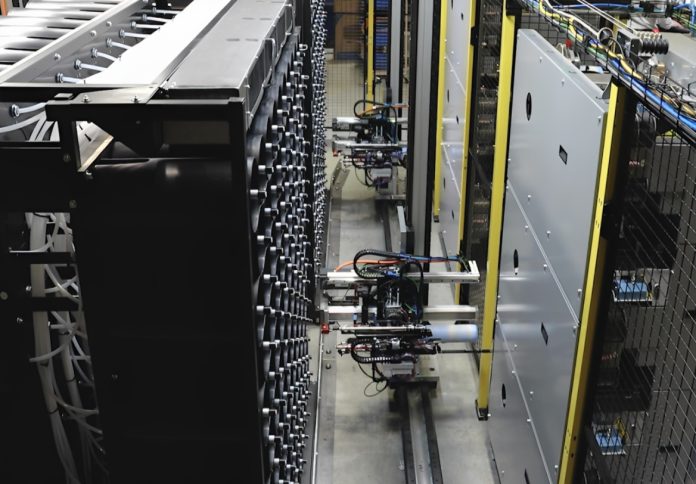
CreelMT prepares yarn packages offline and delivers them to a tufting machine ready for installation, with the aim of reducing production interruptions and improving yarn preparation accuracy.
Smith said the project, which began in July 2020, required a flexible machine architecture capable of accommodating different customer requirements while maintaining a common control platform.
“CreelMT combines a wide range of machine functions, including precision servo motion, distributed I/O, safety systems, operator interfaces, job management, diagnostics, mobile creel trolley handling and communication with external equipment,” he said.
The machine uses Beckhoff’s PC-based control platform, with TwinCAT software and EtherCAT communication technology integrating its various functions. Smith said this approach reduced engineering complexity by providing a single environment for PLC logic, motion control, safety, HMI communications, robotics integration and diagnostics.
“For customers, this translates into improved machine availability, reduced commissioning time and higher overall productivity,” Smith said.
The development also presented challenges, particularly in coordinating multiple machine functions while accommodating different tufting machine models, yarn types, trolley configurations, factory layouts and production processes.
Beckhoff said performance can be assessed through measures including tufting machine downtime, changeover times, yarn preparation, yarn length accuracy and overall machine availability. Smith said the integrated system also provides diagnostics across the controller, EtherCAT devices, servo drives and safety systems.
“This reduces downtime, improves serviceability and enables effective remote support when required,” he said.
Saleem said the project demonstrated how a modular automation architecture could be expanded as customer requirements change, including through additional axes, I/O, robotics systems or machine modules.
“Automation is increasingly becoming the key differentiator for manufacturers looking to improve productivity while remaining globally competitive,” he said.
Saleem added that open automation platforms could allow machine builders to integrate technologies such as machine vision, data analytics and Industry 4.0 capabilities as manufacturing requirements evolve.
Beckhoff said the CreelMT project also highlights the role of Australian engineering in developing manufacturing technology for international markets, although the release did not provide specific customer performance figures or quantify productivity gains from the system.