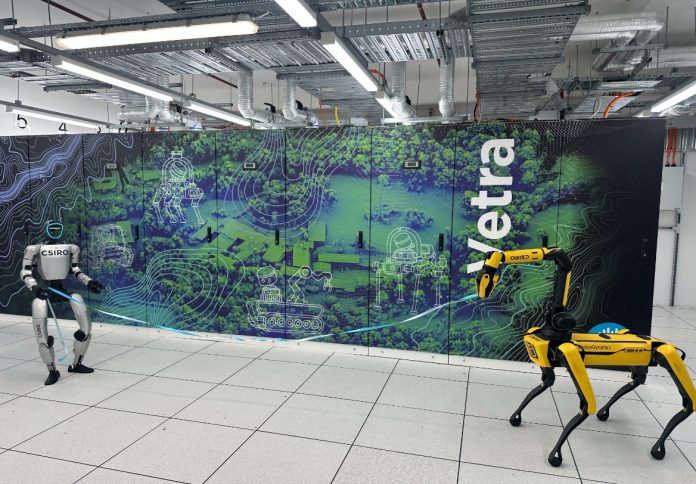
CSIRO has launched new artificial intelligence infrastructure designed to bring high-performance computing closer to where data is generated, supporting real-time learning for robots and other physical AI systems as demand grows for faster, on-site processing.
The system, named Vetra and based at CSIRO’s Queensland Centre for Advanced Technologies in Pullenvale, is intended to support “edge AI” applications by enabling processing directly alongside robots and sensors rather than relying solely on remote cloud systems.
CSIRO said the shift reflects growing use of AI in physical environments where speed and reliability are critical. “AI is rapidly moving beyond digital systems into the physical world, including robots, infrastructure, sensing and safety critical environments,” said Dr Liming Zhu, Director of CSIRO’s Data61.
He said Vetra is designed to provide “sovereign, trusted AI computing at the edge,” allowing systems to process and respond to data in real time.
“Vetra enables real-time physical AI research by bringing high performance computing to the edge, where proximity to data allows systems to respond, learn and operate safely in complex environments in ways that are not possible with cloud only or distant data centre approaches,” Dr Zhu said.
CSIRO said Vetra operates alongside its larger supercomputing systems in Canberra as part of an “edge-core-cloud” model, where immediate processing is handled locally before data is sent for deeper analysis. Dr Peyman Moghadam, Head of CSIRO’s Embodied AI Cluster, said this approach is essential for robotics development in real-world environments.
“Robots and physical AI systems need to keep learning from the physical world, not just from internet datasets or simulations,” Dr Moghadam said. “Vetra gives us the missing edge layer for this workflow, helping turn real-world robotics data into better, safer and more adaptable AI systems.”
The infrastructure has also been designed with energy efficiency in mind, using carbon dioxide-based cooling and closed-loop liquid cooling systems to reduce reliance on water-intensive methods.
CSIRO said this approach significantly reduces environmental impact, with the system expected to save about 225 tonnes of carbon dioxide emissions annually, equivalent to removing around 50 cars from Queensland roads each year.
CSIRO Chief Technology Officer Angus Macoustra said sustainability was a core design consideration. “High-performance AI systems generate a lot of heat in dense, enclosed spaces. Vetra shows how advanced technology can be delivered in a way that significantly reduces water use and emissions,” he said.
Vetra includes 48 high-performance graphics processing units and was developed with support from Australian small and medium-sized businesses, including Oper8 Global and XENON, alongside international technology partners.