EPFL engineers have developed hollow acoustic cavities that can convert sound waves into directional thrust, a technique they say could enable small robots and ultralight aerial vehicles to move without conventional on-board actuators or electronics.
The research, conducted by the MicroBioRobotic Systems (MICROBS) Lab at EPFL’s School of Engineering and published in Science Advances, is based on the principle of Helmholtz resonance, in which air trapped inside a cavity oscillates strongly when excited at specific frequencies.
“Instead of pushing devices around with sound waves, we have created acoustic resonators that are tuned to harness sound at specific frequencies to generate directional thrust and controlled motion,” said Selman Sakar, head of the MICROBS Lab. “Our work shows the feasibility of transforming a simple, cleverly designed mechanical piece into robotic matter.”
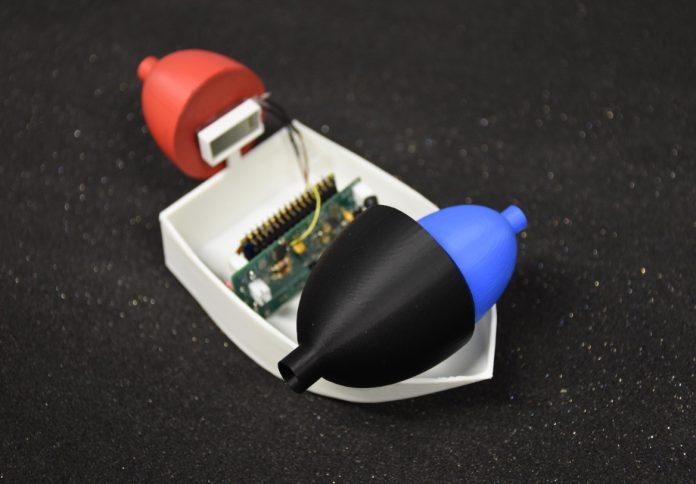
The researchers fabricated hollow, round or bell-shaped structures that generate thrust by concentrating oscillating air into a directional jet. According to EPFL, the resulting imbalance between the concentrated outgoing airflow and more diffuse incoming airflow can propel small vehicles.
The cavities can be manufactured using materials including 3D-printing plastics, rubber-like polymers and glass. At centimetre scale, the team produced miniature boats fitted with up to three cavities, each tuned to a different audible frequency.
By changing the frequency emitted by a speaker, the researchers could selectively activate the cavities to move the boats in different directions. EPFL said the approach allowed the boats to be steered around obstacles and programmed for autonomous navigation.
The team also used a 3D nanoprinting technique to manufacture ultralight flying vehicles, or “microfliers”, with microscopic cavities integrated into their polymer structures. These devices operated using ultrasonic frequencies that are inaudible to humans.
One microflier weighing 150 micrograms used its cavities to produce upward thrust, while another incorporated the cavities with miniature blades that reached speeds of up to 13,000 revolutions per minute to produce aerodynamic lift.
EPFL said the absence of conventional motors, gears and magnetic components could allow the structures to be manufactured at very small scales using different 3D-printing techniques.
“Our concept is compatible with even further miniaturization, enabling advanced designs that push the boundaries of robotics and aeronautics,” said Junsun Hwang, first author of the study and a PhD student at the MICROBS Lab.
Sakar said the concept could eventually involve multiple sound-responsive structures integrated into a single flexible device, with individual elements responding to different frequencies.
“This would allow specific parts of the device to move, bend or vibrate, potentially leading to aerodynamic robotic devices that can change shape in response to sound,” he said.