Manufacturing advances at RMIT University have supported the development of a prototype neuromorphic vision system that researchers say could eventually contribute to smart bionic eyes and other low-energy artificial intelligence technologies.
Led by Professor Sumeet Walia at RMIT’s Centre for Opto-electronic Materials and Sensors, the research combines sensing, memory and information processing in a single system, reducing the need to move data between separate sensors, memory and processors.
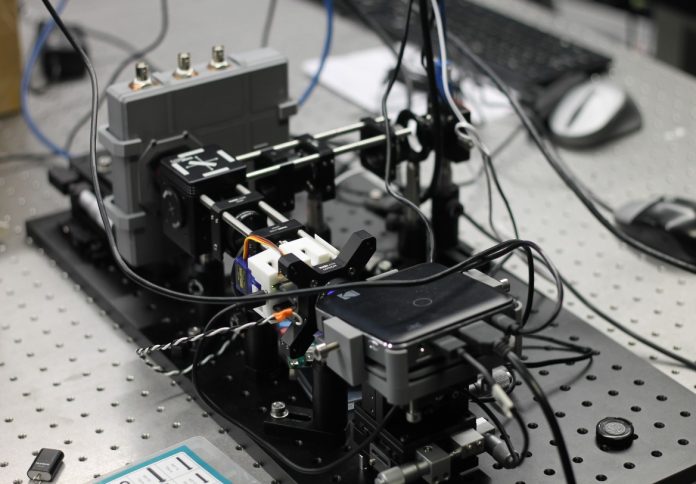
The prototype uses atom-thin molybdenum disulfide (MoS2), with sensing, processing and storage integrated into a 2cm by 2cm chip. RMIT said researchers have trained the system to recognise patterns including numbers, shapes and movement, and detect and store changes in its visual environment.
“This is not just a sensor that captures information, it’s a sensor that can also process information,” co-researcher Dr Taimur Ahmed said.
The research team also developed a water-based fabrication process to transfer the semiconductor and electrodes, which RMIT said produced fewer defects and improved electrical and light-sensing performance compared with conventional methods.
“Nature has already solved many of the challenges we’re trying to address in electronics,” Walia said. “The human eye and brain work together incredibly efficiently, processing vast amounts of information using remarkably little energy.”
RMIT said the technology remains an early-stage research demonstration, with practical applications still years away. Potential future uses could include machine vision, autonomous vehicles, robotics and intelligent sensors.
Walia said the technology could also have implications for the energy demands of AI if it can eventually be scaled.
“If this RMIT technology can be scaled up, it could help reduce the amount of data that needs to be moved, stored and processed, making future AI systems more energy efficient,” he said.
RMIT has filed an international patent application under the Patent Cooperation Treaty for the invention. The research has been published in ACS Applied Materials and Interfaces and Advanced Materials Technologies.