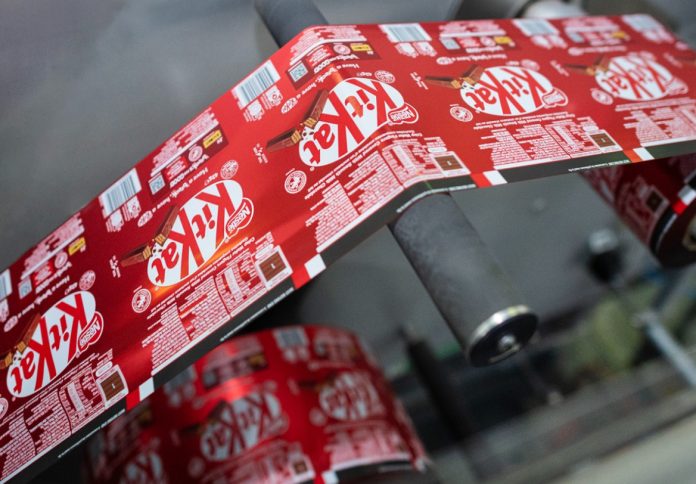
Australian manufacturing capability for recycled plastics is being demonstrated through a trial that has produced locally manufactured recycled polypropylene for use in a limited run of Nestlé KitKat wrappers.
According to Taghleef Industries, the project involved Viva Energy processing soft plastic pyrolysis oil at its Geelong Refinery before five tonnes of recycled polypropylene were processed through a Victorian downstream supply chain. Taghleef Industries and Amcor worked with Nestlé to produce seven million bespoke KitKat wrappers in March 2026.
The trial builds on a 2022 collaboration between Viva Energy and Nestlé that introduced recycled soft plastic packaging for KitKat 4 Finger bars. The latest project aimed to demonstrate whether the supply chain, from refinery processing through to food-grade packaging, could be completed domestically.
Viva Energy said more than 9.5 tonnes of plastic pyrolysis oil was processed at the Geelong Refinery in 2025 as part of the proof-of-concept. The company said its refinery and polymers plant provide the only Australian facility currently capable of chemically recycling used soft plastics into food-grade plastic feedstock.
Viva Energy Executive General Manager Energy and Infrastructure Bill Patterson said the project demonstrated the potential of existing manufacturing infrastructure.
“Geelong Refinery is Australia’s last remaining site with this level of refining and processing capability and its only manufacturer of polypropylene,” Patterson said.
“We have proven the use of soft plastics pyrolysis oil as a feedstock and demonstrated how existing industrial infrastructure can be adapted to support a circular plastics economy.”
Nestlé Oceania General Manager Confectionery Andrew Lawrey said the limited production run was intended to test new approaches to soft plastic recycling.
“This collaboration demonstrates what’s possible when industry works together to tackle packaging challenges and accelerate the transition to a more circular economy,” Lawrey said.
The companies noted that the trial was a single batch rather than an established ongoing manufacturing supply chain. They also said pyrolysis oil used in the project was imported because suitable local supply is not yet available at scale.
Viva Energy said further development of domestic circular supply chains would require policy support for soft plastic collection, sorting and recycling, as well as investment in recycling and advanced manufacturing infrastructure.
Lawrey said extended producer responsibility could help provide greater certainty for investment in recycling.
“Maintaining momentum on EPR and supporting sovereign recycling capability will be critical to unlocking circularity at scale and keeping valuable materials in the local economy,” he said.
Viva Energy and Cleanaway are continuing a feasibility study into a larger-scale plastic recycling project, with the next engineering phase expected to begin after details of the Australian Government’s packaging reform have been finalised.