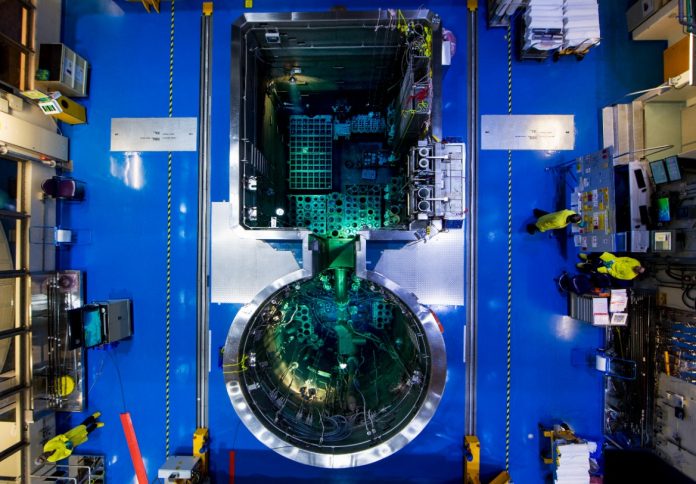
Australia’s manufacturing sector has been among the industries supported by the Australian Nuclear Science and Technology Organisation’s (ANSTO) OPAL multi-purpose reactor, which has reached 20 years since first achieving criticality at the organisation’s Lucas Heights campus.
In a news release, ANSTO stated that OPAL reached criticality on 12 August 2006, marking the transition from construction to operational research capability.
ANSTO said the reactor has since supported applications spanning nuclear medicine, materials research, semiconductor production and advanced manufacturing.
ANSTO CEO Shaun Jenkinson said the anniversary provided an opportunity to recognise the reactor’s contribution across different sectors.
“For 20 years, OPAL has delivered benefits that reach into hospitals, industries, universities and communities across Australia,” Jenkinson said.
A key industrial application is the irradiation of silicon used to produce high-performance semiconductors. ANSTO said OPAL is the world’s largest irradiator of Neutron Transmutation Doped silicon, with more than 900 tonnes of silicon ingots irradiated in the reactor’s pool.
According to ANSTO, the silicon is used in technologies including electric vehicles, smart grids, renewable energy infrastructure, robotics and aerospace.
The reactor also supports research into materials and manufacturing through the Australian Centre for Neutron Scattering. ANSTO said more than 8,000 scientific experiments have been conducted over the past 20 years, including research relating to advanced manufacturing and materials science.
“ANSTO is highly regarded as a global leader in nuclear research and technology, and this reputation is built on the enormous capabilities of OPAL,” Jenkinson said.
OPAL has also supported the production of more than 10 million nuclear medicine doses since becoming operational, with the medicines supplied to hospitals and medical clinics across Australia, according to ANSTO.
The reactor was designed, constructed and commissioned over four years by Argentine nuclear technology company INVAP, working with Australian alliance partners John Holland Construction and Engineering and Evans Deakin Industries Limited. More than 500 workers were employed on site at the peak of construction.
ANSTO said OPAL continues to support workforce training and the development of nuclear expertise, including in areas relevant to Australia’s future nuclear capabilities.
“It plays a crucial role in the training and development of Australia’s growing nuclear workforce, including for future national priorities such as AUKUS,” Jenkinson said.