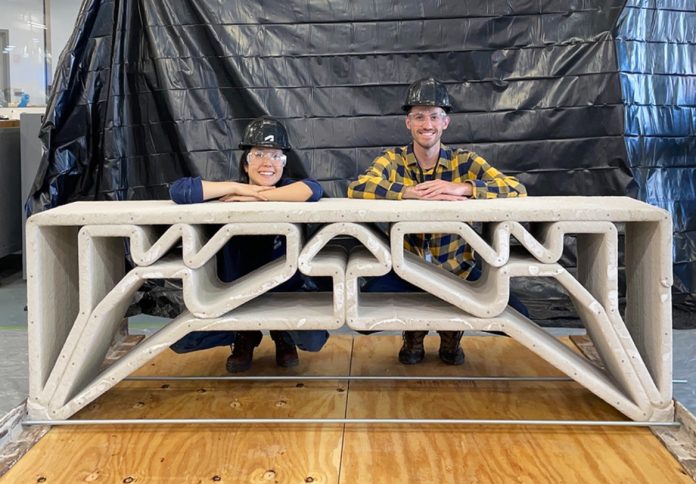
MIT researchers have developed a design framework aimed at improving the manufacturing of 3D-printed concrete structures by incorporating the real-world limitations of printing hardware directly into the design process, potentially reducing material use and lowering the carbon footprint of construction.
According to MIT, the framework, described in the journal Additive Manufacturing, enables engineers to generate designs that are optimised not only for structural performance but also for manufacturability. The researchers demonstrated the approach by designing, printing and load-testing a 2.3-metre concrete bridge.
“We were finding a lot of cracks you can fall through when it comes to translating these super-optimal designs into manufacturable designs,” said co-first author Hajin Kim-Tackowiak, a postdoctoral researcher in MIT’s Department of Civil and Environmental Engineering. “Those cracks were like chasms.”
The team worked with engineers at Autodesk’s Technology Center in Boston to identify practical constraints affecting large-scale concrete printing, including bead width, turning radius and the need to print in a continuous path. Those limitations were then incorporated directly into the optimisation process.
Kim-Tackowiak said conventional approaches often require significant redesign after optimisation. By comparison, the new framework generated printable designs in about two minutes on a laptop, allowing rapid adjustments when needed.
“Reaching that speed at all is recent,” said co-first author Zane Schemmer, a PhD student in MIT’s Department of Civil and Environmental Engineering. “You go back five, 10 years ago, the solver we used, even three years ago, could not solve these problems. This field has been avoided, because everyone thinks that’s not an avenue we can go down. But with new algorithms and resources, it’s becoming a way we can start to frame problems.”
To validate the method, the researchers produced a concrete bridge measuring 2.3 metres in length using commercially available mortar.
“The bridge took about 30 minutes to make and was built from off-the-shelf mortar,” said senior author Josephine Carstensen, the Gilbert W. Winslow (1937) Career Development Professor in Civil Engineering at MIT.
Testing showed the approximately 900-pound bridge supported more than 2,000 pounds of distributed load with virtually no measurable bending, closely matching the team’s simulations.
The researchers said the results indicated that current manufacturing equipment, rather than the strength of the concrete itself, was the main factor limiting material efficiency.
“What we found was our result was super over-engineered,” Kim-Tackowiak said. “From zero to 200,000 pounds, your design is entirely driven by these ‘can I build it or not’ constraints. And then, after 200,000 pounds, you can start to think about the physics.”
Using the optimisation framework, the team also evaluated how improvements in printing hardware could reduce material consumption. Carstensen said reducing the printed bead width from four centimetres to one centimetre could lower material use by as much as 76 per cent while remaining within safety margins.
“Because we know we’re finding the best solution out there, we can also quantify: If we had a machine that could do other things, what would that mean for how much material we’re using?” Carstensen said.
The researchers said the findings provide guidance for future manufacturing equipment development by identifying which hardware improvements could deliver the greatest efficiency gains. They are now exploring reinforced concrete printing, although Kim-Tackowiak noted that integrating reinforcing steel into printed concrete structures remains a significant technical challenge.